Showing posts with label Legal history. Show all posts

Wednesday, November 13, 2019

The Ambivalence of Good

Jan Eckel, The Ambivalence of Good: Human Rights in International Politics Since the 1940s (Oxford University Press, 2019).
The Ambivalence of Good examines the genesis and evolution of international human rights politics since the 1940s. Focusing on key developments such as the shaping of the UN human rights system, decolonization, the rise of Amnesty International, the campaigns against the Pinochet dictatorship, the moral politics of Western governments, and dissidence in Eastern Europe, the book traces how human rights profoundly, if subtly, transformed global affairs.
-Publisher's Description

Wednesday, November 6, 2019

Justice Blindfolded

Adriano Prosperi, Justice Blindfolded: The Historical Course of an Image (Brill, 2018).
Justice Blindfolded gives an overview of the history of "justice" and its iconography through the centuries. Justice has been portrayed as a woman with scales, or holding a sword, or, since the fifteenth century, with her eyes bandaged. This last symbol contains the idea that justice is both impartial and blind, reminding indirectly of the bandaged Christ on
the cross, a central figure in the Christian idea of fairness and forgiveness.
-Publisher's Description

Friday, May 24, 2019

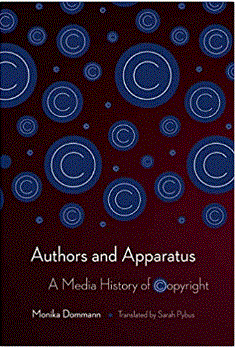
Authors and Apparatus: A Media History of Copyright

Monika Dommann (University of Zurich), Authors and Apparatus: A Media History of Copyright (Cornell University Press 2019).


Copyright is under siege. From file sharing to vast library scanning projects, new technologies, actors, and attitudes toward intellectual property threaten the value of creative work. However, while digital media and the Internet have made making and sharing perfect copies of original works almost effortless, debates about protecting authors' rights are nothing new. In this sweeping account of the evolution of copyright law since the mid-nineteenth century, Monika Dommann explores how radical media changes―from sheet music and phonographs to photocopiers and networked information systems―have challenged and transformed legal and cultural concept of authors' rights. 

Dommann provides a critical transatlantic perspective on developments in copyright law and mechanical reproduction of words and music, charting how artists, media companies, and lawmakers in the United States and western Europe approached the complex tangle of technological innovation, intellectual property, and consumer interests. From the seemingly innocuous music box, invented around 1800, to BASF's magnetic tapes and Xerox machines, she demonstrates how copyright has been continuously destabilized by emerging technologies, requiring new legal norms to regulate commercial and private copying practices. Without minimizing digital media's radical disruption to notions of intellectual property, Dommann uncovers the deep historical roots of the conflict between copyright and media―a story that can inform present-day debates over the legal protection of authorship.
- Publisher's Description                                       


Friday, March 22, 2019

Justice in Plain Sight: How a Small-Town Newspaper and Its Unlikely Lawyer Opened America's Courtrooms

Dan Bernstein, Justice in Plain Sight: How a Small-Town Newspaper and Its Unlikely Lawyer Opened America's Courtrooms (University of Nebraska Press 2019).


Justice in Plain Sight is the story of a hometown newspaper in Riverside, California, that set out to do its job: tell readers about shocking crimes in their own backyard. But when judges slammed the courtroom door on the public, including the press, it became impossible to tell the whole story. Pinning its hopes on business lawyer Jim Ward, whom Press-Enterprise editor Tim Hays had come to know and trust, the newspaper took two cases to the U.S. Supreme Court in the 1980s. Hays was convinced that the public—including the press—needed to have these rights and needed to bear witness to justice because healing in the aftermath of a horrible crime could not occur without community catharsis. The newspaper won both cases and established First Amendment rights that significantly broadened public access to the judicial system, including the right for the public to witness jury selection and preliminary hearings. 

Justice in Plain Sight is a unique story that, for the first time, details two improbable journeys to the Supreme Court in which the stakes were as high as they could possibly be (and still are): the public's trust in its own government.
                                                  -Publisher's description

Friday, April 28, 2017

Law and Order in Anglo-Saxon England

Tom Lambert (Fellow of Sidney Sussex College, Cambridge)Law and Order in Anglo-Saxon England (Oxford Univ. Press 2017). 

"The focus of the volume is on the maintenance of order: what constituted good order; what forms of wrongdoing were threatening to it; what roles kings, lords, communities, and individuals were expected to play in maintaining it; and how that worked in practice. Its core argument is that the Anglo-Saxons had a coherent, stable, and enduring legal order that lacks modern analogies: it was neither state-like nor stateless, and needs to be understood on its own terms rather than as a variant or hybrid of these models. Tom Lambert elucidates a distinctively early medieval understanding of the tension between the interests of individuals and communities, and a vision of how that tension ought to be managed that, strikingly, treats strongly libertarian and communitarian features as complementary."


Publisher's description

Thursday, October 13, 2016

Cultures of Conflict Resolution in Early Modern Europe

Stephen Cummings & Laura Kounine (eds.) (Max Planck Institute for Human Development), Cultures of Conflict Resolution in Early Modern Europe (Rutledge 2016).

"Disputes, discord and reconciliation were fundamental parts of the fabric of communal living in early modern Europe. This edited volume presents essays on the cultural codes of conflict and its resolution in this period under three broad themes: peacemaking as practice; the nature of mediation and arbitration; and the role of criminal law in conflicts. Through an exploration of conflict and peacemaking, this volume provides innovative accounts of state formation, community and religion in the early modern period."


Publisher's description

Monday, September 26, 2016

Authors in Court: Scenes from the Theater of Copyright

Mark Rose (University of California, Santa Barbara), Authors in Court (Harvard University Press 2016).


"Through a series of vivid case studies, Authors in Court charts the 300-year-long dance between authorship and copyright that has shaped each institution’s response to changing social norms of identity, privacy, and celebrity. Authors’ self-presentations in court are often inflected by prevailing concepts of propriety and respectability. And judges, for their part, have not been immune to the reputation and standing of the authors who have appeared before them in legal dramas.

Some authors strut their roles on the public stage. For example, Napoleon Sarony—the nineteenth-century photographer whose case established that photographs might be protected as works of art—was fond of marching along Broadway dressed in a red fez and high-top campaign boots, proclaiming his special status as a celebrity. Others, such as the reclusive J. D. Salinger, enacted their dramas precisely by shrinking from attention. Mark Rose’s case studies include the flamboyant early modern writer Daniel Defoe; the self-consciously genteel poet Alexander Pope; the nineteenth-century abolitionist Harriet Beecher Stowe; the once-celebrated early twentieth-century dramatist Anne Nichols, author of Abie’s Irish Rose; and the provocative contemporary artist Jeff Koons.

These examples suggest not only how social forms such as gender and gentility have influenced the self-presentation of authors in public and in court but also how the personal styles and histories of authors have influenced the development of legal doctrine."

Publisher's description

Tuesday, March 15, 2016

The Watershed of Modern Politics: Law, Virtue, Kingship, and Consent (1300-1650)

Francis Oakley (Williams College), The Watershed of Modern Politics: Law, Virtue, Kingship, and Consent (1300-1650) (Yale University Press, 2015).

JC375 .O25 2015 

"The concluding volume of Francis Oakley's authoritative trilogy moves on to engage the political thinkers of the later Middle Ages, Renaissance, Age of Reformation and religious wars, and the era that produced the Divine Right Theory of Kingship. Oakley's ground-breaking study probes the continuities and discontinuities between medieval and early modern modes of political thinking and dwells at length on the roots and nature of those contract theories that sought to legitimate political authority by grounding it in the consent of the governed." 
Publisher's description

Friday, November 6, 2015

Imperial from the Beginning: The Constitution of the Original Executive


Saikrishna Bangalore Prakash (University of Virginia). Imperial from the Beginning: The Constitution of the Original Executive (Yale University Press, 2015).
 
"Eminent scholar Saikrishna Prakash offers the first truly comprehensive study of the original American presidency. Drawing from a vast range of sources both well known and obscure, this volume reconstructs the powers and duties of the nation’s chief executive at the Constitution’s founding. Among other subjects, Prakash examines the term and structure of the office of the president, as well as the president’s power as constitutional executor of the law, authority in foreign policy, role as commander in chief, level of control during emergencies, and relationship with the Congress, the courts, and the states. This ambitious and even-handed analysis counters numerous misconceptions about the presidency and fairly demonstrates that the office was seen as monarchical from its inception."
—Publisher's description