"Stephen Neff avoids technical jargon as he surveys doctrines from natural law to feminism, and practices from the Warring States of China to the international criminal courts of today. Ancient China produced the first rudimentary set of doctrines. But the cornerstone of later international law was laid by the Romans, in the form of natural law—a universal law that was superior to early laws and governments. . . . New challenges in the nineteenth century encompassed the advance of nationalism, the rise of free trade and European imperialism, the formation of international organizations, and the arbitration of disputes. . . . The twentieth century witnessed the formation of the League of Nations and a World Court, but also the rise of socialist and fascist states and the advent of the Cold War. . . . . As Neff makes clear, further threats to the rule of law today come from environmental pressures, genocide, and terrorism."—Justice among Nations book jacket
Showing posts with label University of Edinburgh. Show all posts
Monday, March 24, 2014
Justice among Nations: A History of International Law
"Stephen Neff avoids technical jargon as he surveys doctrines from natural law to feminism, and practices from the Warring States of China to the international criminal courts of today. Ancient China produced the first rudimentary set of doctrines. But the cornerstone of later international law was laid by the Romans, in the form of natural law—a universal law that was superior to early laws and governments. . . . New challenges in the nineteenth century encompassed the advance of nationalism, the rise of free trade and European imperialism, the formation of international organizations, and the arbitration of disputes. . . . The twentieth century witnessed the formation of the League of Nations and a World Court, but also the rise of socialist and fascist states and the advent of the Cold War. . . . . As Neff makes clear, further threats to the rule of law today come from environmental pressures, genocide, and terrorism."—Justice among Nations book jacket
Friday, February 7, 2014
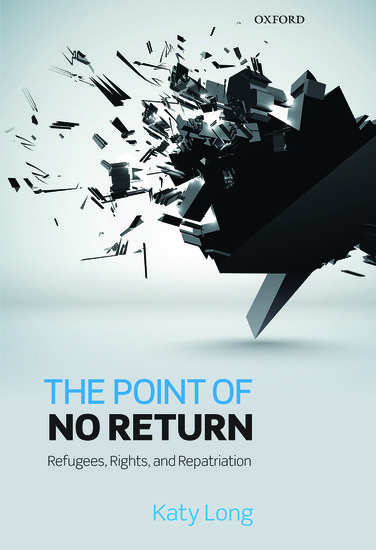
The Point of No Return: Refugees, Rights, and Repatriation
Katy Long (University of Edinburgh). The Point of No Return (Oxford University Press, 2013).
The Point of No Return: Refugees, Rights, and Repatriation sets out . . . to examine the fundamental tensions between liberalism and nationalism that repatriation exposes. It makes clear that repatriation cannot be considered as a mere act of border-crossing, a physical moment of 'return'. Instead, repatriation must be recognized to be a complex political process, involving the remaking of a relationship between citizen and state, the recreation of a social contract.
—The Point of No Return book jacket
The Point of No Return: Refugees, Rights, and Repatriation sets out . . . to examine the fundamental tensions between liberalism and nationalism that repatriation exposes. It makes clear that repatriation cannot be considered as a mere act of border-crossing, a physical moment of 'return'. Instead, repatriation must be recognized to be a complex political process, involving the remaking of a relationship between citizen and state, the recreation of a social contract.
—The Point of No Return book jacket
Subscribe to:
Posts (Atom)