Showing posts with label First Amendment. Show all posts

Monday, May 18, 2020

African Americans and the First Amendment

Timothy C. Shiell, African-Americans and the First Amendment: The Case for Liberty and Equality (State University of New York Press, 2019).
Timothy C. Shiell utilizes an interdisciplinary approach to demonstrate that a strong commitment to greater inclusion and participation. This crucial connection is evidenced throughout US history, from the days of colonial and antebellum slavery to Jim Crow: in the landmark US Supreme Court decision in 1937 freeing the black communist Angelo Herndon; in the struggles and victories of the civil rights movement, from the late 1930s to the late '60s; and in the historical and modern debates over hate speech restrictions. Liberty and equality can conflict in individual cases, Shiell argues, but there is no fundamental conflict between them. Robust First Amendment values protect and encourage demands for racial equality while weak First Amendment values, in contrast, lead to censorship and chilling demands for racial equality.
-Publisher's Description

Friday, March 22, 2019

Justice in Plain Sight: How a Small-Town Newspaper and Its Unlikely Lawyer Opened America's Courtrooms

Dan Bernstein, Justice in Plain Sight: How a Small-Town Newspaper and Its Unlikely Lawyer Opened America's Courtrooms (University of Nebraska Press 2019).


Justice in Plain Sight is the story of a hometown newspaper in Riverside, California, that set out to do its job: tell readers about shocking crimes in their own backyard. But when judges slammed the courtroom door on the public, including the press, it became impossible to tell the whole story. Pinning its hopes on business lawyer Jim Ward, whom Press-Enterprise editor Tim Hays had come to know and trust, the newspaper took two cases to the U.S. Supreme Court in the 1980s. Hays was convinced that the public—including the press—needed to have these rights and needed to bear witness to justice because healing in the aftermath of a horrible crime could not occur without community catharsis. The newspaper won both cases and established First Amendment rights that significantly broadened public access to the judicial system, including the right for the public to witness jury selection and preliminary hearings. 

Justice in Plain Sight is a unique story that, for the first time, details two improbable journeys to the Supreme Court in which the stakes were as high as they could possibly be (and still are): the public's trust in its own government.
                                                  -Publisher's description

Tuesday, November 22, 2016

Free Speech & Human Dignity

Steven J. Heyman (Chicago-Kent College of Law), Free Speech & Human Dignity (Yale Univ. Press 2008).


"In this important book, Steven J. Heyman presents a theory of the First Amendment that seeks to overcome the conflict between free speech and human dignity. This liberal humanist theory recognizes a strong right to freedom of expression while also providing protection against the most serious forms of assaultive speech. Heyman then uses the theory to illuminate a wide range of contemporary disputes, from flag burning and antiabortion demonstrations to pornography and hate speech." 
Publisher's description

Thursday, April 2, 2015

Speech Matters: On Lying, Morality, and the Law

Seana Valentine Shiffrin (UCLA). Speech Matters: On Lying, Morality, and the Law (Princeton University Press, 2014).

"To understand one another as individuals and to fulfill the moral duties that require such understanding, we must communicate with each other. We must also maintain protected channels that render reliable communication possible, a demand that, Seana Shiffrin argues, yields a prohibition against lying and requires protection for free speech. This book makes a distinctive philosophical argument for the wrong of the lie and provides an original account of its difference from the wrong of deception."
Publisher's website


Thursday, January 22, 2015

Deadly Censorship: Murder, Honor, and Freedom of the Press

James Lowell Underwood (University of South Carolina). Deadly Censorship: Murder, Honor, and Freedom of the Press (University of South Carolina Press, 2014).

"On January 15, 1903, South Carolina lieutenant governor James H. Tillman shot and killed Narciso G. Gonzales, editor of South Carolina's most powerful newspaper, the State. Blaming Gonzales's stinging editorials for his loss of the 1902 gubernatorial race, Tillman shot Gonzales to avenge the defeat and redeem his 'honor' and his reputation as a man who took action in the face of an insult. . . . Underwood offers a painstaking re-creation of an act of violence in front of the State House, the subsequent trial, and Tillman's acquittal, which sent shock waves across the United States. A specialist on constitutional law, Underwood has written the definitive examination of the court proceedings, the state's complicated homicide laws, and the violent cult of personal honor that had undergirded South Carolina society since the colonial era."
Publisher's website

Tuesday, December 16, 2014

Comic Art, Creativity and the Law

Marc H. Greenberg (Golden Gate University). Comic Art, Creativity and the Law (Edward Elgar, 2014).

"The creation of works of comic art, including graphic novels, comic books, cartoons and comic strips, and political cartoons, is affected, and at times limited, by a diverse array of laws, ranging from copyright law to free speech laws. This book examines how this intersection affects the creative process, and proposes approaches that encourage, rather than limit, that process in the comic art genre. Attention to the role comic art occupies in popular culture, and how the law responds to that role, is also analyzed."
Publisher's website

Thursday, October 16, 2014

Judging the Boy Scouts of America: Gay Rights, Freedom of Association, and the Dale Case

Richard J. Ellis (Willamette University). Judging the Boy Scouts of America (University Press of Kansas, 2014).

"As Americans, we cherish the freedom to associate. However, with the freedom to associate comes the right to exclude those who do not share our values and goals. What happens when the freedom of association collides with the equally cherished principle that every individual should be free from invidious discrimination? This is precisely the question posed in Boy Scouts of America v. James Dale, a lawsuit that made its way through the courts over the course of a decade, culminating in 2000 with a landmark ruling by the U.S. Supreme Court. In Judging the Boy Scouts of America, Richard J. Ellis tells the fascinating story of the Dale case, placing it in the context of legal principles and precedents, Scouts’ policies, gay rights, and the 'culture wars' in American politics."
—Publisher's Website

Thursday, May 8, 2014

The Progeny: Justice William J. Brennan's Fight to Preserve the Legacy of New York Times v. Sullivan

Lee Levine & Stephen Wermiel. The Progeny (American Bar Association, 2014).

"New York Times Co. v. Sullivan, credited with defining the central meaning of the First Amendment, has protected the freedom of expression for the past 50 years. This compelling work of historical non-fiction focuses on the progeny of that decision, examining how Justice Brennan nurtured and developed the constitutional law of defamation and related claims.

The book draws on the previously unreported papers of Justice Brennan and several of his colleagues and, through them as well as author Stephen Wermiel's private interviews with Brennan, provides the authoritative historical account of how an important body of constitutional law came to be. The Progeny offers fresh insights with respect to both what the law means and the process by which it was formulated."

From publisher's website 

Tuesday, March 18, 2014

The Rise and Decline of American Religious Freedom

Steven D. Smith (University of San Diego). The Rise and Decline of American Religious Freedom (Harvard University Press, 2014).

"Smith maintains that the distinctive American contribution to religious freedom was not in the First Amendment, which was intended merely to preserve the political status quo in matters of religion. What was important was the commitment to open contestation between secularist and providentialist understandings of the nation which evolved over the nineteenth century. In the twentieth century, far from vindicating constitutional principles, as conventional wisdom suggests, the Supreme Court imposed secular neutrality, which effectively repudiated this commitment to open contestation."
The Rise and Decline of American Religious Freedom book jacket

Friday, February 14, 2014

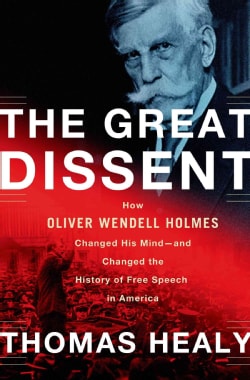
The Great Dissent: How Oliver Wendell Holmes Changes His Mind — and Changed the History of Free Speech in America

Thomas Healy (Seton Hall).  The Great Dissent (Metropolitan Books, 2013).

"Now, with the aid of newly discovered letters and confidential memos, law professor Thomas Healy reconstructs in vivid detail Holmes's journey from free-speech opponent to First Amendment hero.  It is the story of a remarkable behind-the-scenes campaign by a group of progressives to bring a legal icon to their way of thinking—and a deeply touching human narrative of an old man saved from his loneliness and despair by a few unlikely young friends."

The Great Dissent book jacket