Showing posts with label Supreme Court decisions. Show all posts

Friday, May 13, 2022

Critical Race Judgments

Bennett Capers, Devon W. Carbado, R. A. Lenhardt & Angela Onwuachi-Willig, Critical Race Judgments: Rewritten U.S. Court Opinions on Race and the Law (Cambridge University Press, 2022).


By re-writing U.S. Supreme Court opinions that implicate critical dimensions of racial justice, Critical Race Judgments demonstrates that it’s possible to be judge and a critical race theorist. Specific issues covered in these cases include the death penalty, employment, voting, policing, education, the environment, justice, housing, immigration, sexual orientation, segregation, and mass incarceration. While some rewritten cases – Plessy v. Ferguson (which constitutionalized Jim Crow) and Korematsu v. United States (which constitutionalized internment) – originally focused on race, many of the rewritten opinions – Lawrence v. Texas (which constitutionalized sodomy laws) and Roe v. Wade (which constitutionalized a woman’s right to choose) – are used to incorporate racial justice principles in novel and important ways. This work is essential for everyone who needs to understand why critical race theory must be deployed in constitutional law to uphold and advance racial justice principles that are foundational to U.S. democracy.

-Publisher's Description

Monday, February 6, 2017

Against the Death Penalty

Justice Stephen Breyer, Against the Death Penalty (Brookings Institute 2016).

"This volume contains Breyer’s dissent in the case of Glossip v. Gross, which involved an unsuccessful challenge to Oklahoma’s use of a lethal-injection drug because it might cause severe pain. Justice Breyer’s legal citations have been edited to make them understandable to a general audience, but the text retains the full force of his powerful argument that the time has come for the Supreme Court to revisit the constitutionality of the death penalty."
—From Publisher's description

Tuesday, August 2, 2016

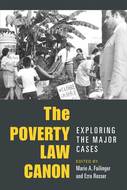
The Poverty Law Canon

Marie A. Failinger (Mitchell Hamline School of Law) & Ezra Rosser (American University) (eds.), The Poverty Law Canon (Univ. of Michigan Press 2016).

"The Poverty Law Canon takes readers into the lives of the clients and lawyers who brought critical poverty law cases in the United States. These cases involved attempts to establish the right to basic necessities, as well as efforts to ensure dignified treatment of welfare recipients and to halt administrative attacks on federal program benefit levels. They also confronted government efforts to constrict access to justice, due process, and rights to counsel in child support and consumer cases, social welfare programs, and public housing. By exploring the personal narratives that gave rise to these lawsuits as well as the behind-the-scenes dynamics of the Supreme Court, the text locates these cases within the social dynamics that shaped the course of litigation."
—Publisher's description

Thursday, October 16, 2014

Judging the Boy Scouts of America: Gay Rights, Freedom of Association, and the Dale Case

Richard J. Ellis (Willamette University). Judging the Boy Scouts of America (University Press of Kansas, 2014).

"As Americans, we cherish the freedom to associate. However, with the freedom to associate comes the right to exclude those who do not share our values and goals. What happens when the freedom of association collides with the equally cherished principle that every individual should be free from invidious discrimination? This is precisely the question posed in Boy Scouts of America v. James Dale, a lawsuit that made its way through the courts over the course of a decade, culminating in 2000 with a landmark ruling by the U.S. Supreme Court. In Judging the Boy Scouts of America, Richard J. Ellis tells the fascinating story of the Dale case, placing it in the context of legal principles and precedents, Scouts’ policies, gay rights, and the 'culture wars' in American politics."
—Publisher's Website

Monday, June 30, 2014

Baseball on Trial: The Origin of Baseball's Antitrust Exemption

Nathaniel Grow (University of Georgia). Baseball on Trial (University of Illinois Press, 2014).

"The controversial 1922 Federal Baseball Supreme Court ruling held that the "business of base ball" was not subject to the Sherman Antitrust Act because it did not constitute interstate commerce. In Baseball on Trial, legal scholar Nathaniel Grow defies conventional wisdom to explain why the unanimous Supreme Court opinion authored by Justice Oliver Wendell Holmes, which gave rise to Major League Baseball's exemption from antitrust law, was correct given the circumstances of the time."


—Publisher's website