Justice Stephen Breyer, Against the Death Penalty (Brookings Institute 2016).
"This volume contains Breyer’s dissent in the case of Glossip v. Gross, which involved an unsuccessful challenge to Oklahoma’s use of a lethal-injection drug because it might cause severe pain. Justice Breyer’s legal citations have been edited to make them understandable to a general audience, but the text retains the full force of his powerful argument that the time has come for the Supreme Court to revisit the constitutionality of the death penalty."
—From Publisher's description
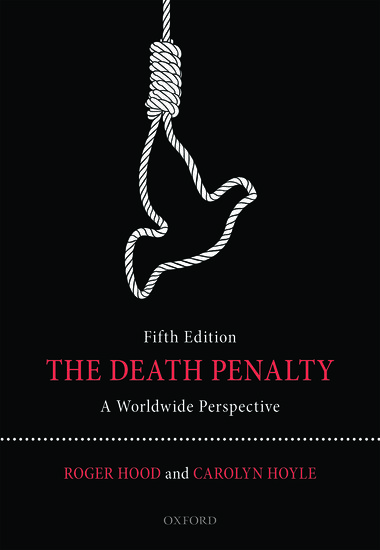
Roger Hood & Carolyn Hoyle (University of Oxford), The Death Penalty: A Worldwide Perspective (Oxford University Press, 5th ed. 2015).
 "The fifth edition of this highly praised study charts and explains the progress that continues to be made towards the goal of worldwide abolition of the death penalty. The majority of nations have now abolished the death penalty and the number of executions has dropped in almost all countries where abolition has not yet taken place. Emphasising the impact of international human rights principles and evidence of abuse, the authors examine how this has fuelled challenges to the death penalty and they analyse and appraise the likely obstacles, political and cultural, to further abolition. They discuss the cruel realities of the death penalty and the failure of international standards always to ensure fair trials and to avoid arbitrariness, discrimination and conviction of the innocent: all violations of the right to life. They provide further evidence of the lack of a general deterrent effect; shed new light on the influence and limits of public opinion; and argue that substituting for the death penalty life imprisonment without parole raises many similar human rights concerns
."
—Publisher's website
 Doron S. Ben-Atar (Fordham University) & Richard D. Brown (University of Connecticut). Taming Lust (University of Pennsylvania, 2014).
"In 1796, as revolutionary fervor waned and the Age of Reason took hold, an eighty-five-year-old Massachusetts doctor was convicted of bestiality and sentenced to hang. Three years later and seventy miles away, an eighty-three-year-old Connecticut farmer was convicted of the same crime and sentenced to the same punishment. Prior to these criminal trials, neither Massachusetts nor Connecticut had executed anyone for bestiality in over a century. Though there are no overt connections between the two episodes, the similarities of their particulars are strange and striking. Historians Doron S. Ben-Atar and Richard D. Brown delve into the specifics to determine what larger social, political, or religious forces could have compelled New England courts to condemn two octogenarians for sexual misbehavior typically associated with much younger men."
—Publisher's website