Showing posts with label Computer law. Show all posts

Friday, June 21, 2019

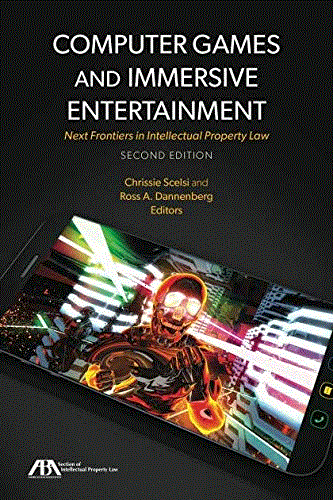
Computer Games and Immersive Entertainment: Next Frontiers in Intellectual Property Law

Computer Games and Immersive Entertainment: Next Frontiers in Intellectual Property Law (Chrissie Scelsi & Ross A. Dannenberg eds., ABA 2d ed. 2018).


A one-of-a-kind, cutting-edge resource, this book explores and discusses how to obtain traditional IP rights in the non-traditional settings of video game and immersive environments, and serves as a primer for practitioners researching these emerging legal issues. Each chapter covers important IP issues involved with computer games and immersive entertainment, including end-user license agreements, copyrights, patents, trademarks, trade secrets, rights of publicity, and international considerations.
- Publisher's description                                 

Tuesday, December 27, 2016

Infocrime: Protecting Information through Criminal Law

Eli Lederman, Infocrime: Protecting Information through Criminal Law (Edward Elgar 2016).

"It has often been said that information is power. This is more true in the information age than ever. The book profiles the tools used by criminal law to protect confidential information. It deals with the essence of information, the varieties of confidential information, and the basic models for its protection within the context of the Internet and social networks.

Eli Lederman examines the key prohibitions against collecting protected information, and against using, disclosing, and disseminating it without authorization. The investigation cuts across a broad subject matter to discuss and analyze key topics such as trespassing and peeping, the human body as a source of information, computer trespassing, tracking and collecting personal information in the public space, surveillance, privileged communications, espionage and state secrets, trade secrets, personal information held by others, and profiling and sexting."
 
Publisher's description

Friday, February 13, 2015

The Cambridge Handbook of Artificial Intelligence

Keith Frankish (University of Crete) & William M. Ramsey (University of Nevada, Las Vegas) (eds.). The Cambridge Handbook of Artificial Intelligence (Cambridge University Press, 2014).

"Artificial intelligence, or AI, is a cross-disciplinary approach to understanding, modeling, and creating intelligence of various forms. . . . AI applications are transforming the way we interact with each other and with our environment, and work in artificially modeling intelligence is offering new insights into the human mind and revealing new forms mentality can take. This volume of original essays presents the state of the art in AI, surveying the foundations of the discipline, major theories of mental architecture, the principal areas of research, and extensions of AI such as artificial life. With a focus on theory rather than technical and applied issues, the volume will be valuable not only to people working in AI, but also to those in other disciplines wanting an authoritative and up-to-date introduction to the field."
Publisher's website


Thursday, November 6, 2014

What Stays in Vegas: The World of Personal Data—Lifeblood of Big Business—and the End of Privacy as We Know It

Adam Tanner (Harvard University). What Stays in Vegas: The World of Personal Data—Lifeblood of Big Business—and the End of Privacy as We Know It (PublicAffairs, 2014).

"Caesars’ dogged data-gathering methods have been so successful that they have grown to become the world’s largest casino operator, and have inspired companies of all kinds to ramp up their own data mining in the hopes of boosting their targeted marketing efforts. Some do this themselves. Some rely on data brokers. Others clearly enter a moral gray zone that should make American consumers deeply uncomfortable. . . . We live in an age when our personal information is harvested and aggregated whether we like it or not. And it is growing ever more difficult for those businesses that choose not to engage in more intrusive data gathering to compete with those that do."
—Publisher's Website

Tuesday, September 2, 2014

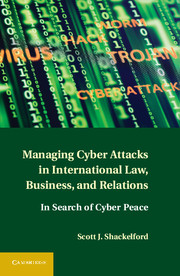
Managing Cyber Attacks in International Law, Business, and Relations: In Search of Cyber Peace

Scott J. Shackelford (Indiana University). Managing Cyber Attacks in International Law, Business, and Relations (Cambridge University Press, 2014). 
 
"This book presents a novel framework to reconceptualize Internet governance and better manage cyber attacks. Specifically, it makes an original contribution by examining the potential of polycentric regulation to increase accountability through bottom-up action. It also provides a synthesis of the current state of cybersecurity research, bringing features of the cloak and dagger world of cyber attacks to light and comparing and contrasting the cyber threat to all relevant stakeholders. Throughout the book, cybersecurity is treated holistically, covering outstanding issues in law, science, economics, and politics."
Publisher's website

Friday, December 13, 2013

Wrap Contracts: Foundations and Ramifications

Nancy S. Kim (California Western). Wrap Contracts: Foundations and Ramifications (Oxford University Press, 2013).

"[Nancy Kim] explains how businesses and existing law unfairly burden users and create a coercive contracting environment that forces users to 'accept' in order to participate in modern life.  Kim's central thesis is that how a contract is presented affects and reveals the intent of the parties.  She proposes doctrinal solutions to fairly balance the burdens of wrap contracts between businesses and consumers."
Wrap Contracts book jacket