Showing posts with label Gay rights. Show all posts

Monday, November 28, 2016

Fragmented Citizens: The Changing Landscape of Gay and Lesbian Lives

Stephen M. Engel, Fragmented Citizens: The Changing Landscape of Gay and Lesbian Lives (N.Y.U. Press 2016).

"In Fragmented Citizens, Stephen M. Engel contends that the present moment in gay and lesbian rights in America is indeed one of considerable advancement and change—but that there is still much to be done in shaping American institutions to recognize gays and lesbians as full citizens. With impressive scope and fascinating examples, Engel traces the relationship between gay and lesbian individuals and the government from the late nineteenth century through the present. Engel shows that gays and lesbians are more accurately described as fragmented citizens. Despite the marriage ruling, Engel argues that LGBT Americans still do not have full legal protections against workplace, housing, family, and other kinds of discrimination. There remains a continuing struggle of the state to control the sexuality of gay and lesbian citizens—they continue to be fragmented citizens."
Publisher's description

Thursday, May 12, 2016

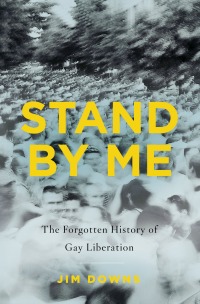
Stand by Me: The Forgotten History of Gay Liberation

Jim Downs (Connecticut College), Stand By Me: The Forgotten History of Gay Liberation (Basic Books 2016).

"In Stand by Me, the acclaimed historian Jim Downs rewrites the history of gay life in the 1970s, arguing that the decade was about much more than sex and marching in the streets. Drawing on a vast trove of untapped records at LGBT community centers in Los Angeles, New York, and Philadelphia, Downs tells moving, revelatory stories of gay people who stood together—as friends, fellow believers, and colleagues—to create a sense of community among people who felt alienated from mainstream American life."
 —Publisher's description

Wednesday, July 29, 2015

Below the Radar: How Silence can Save Civil Rights

Alison L. Gash (University of Oregon). Below the Radar: How Silence can Save Civil Rights (Oxford University Press, 2015).  

"Drawing from interviews with advocates and opponents, the book introduces readers to two sets of civil rights battles in which advocates devised strategies to remain 'under the radar' and away from the prying eyes of a volatile public. In so doing they diminished both the incidence and influence of backlash. Advocates working on behalf of lesbian and gay parents relied on lower court rulings, family law, and less polarizing frames to advance custody and co-parenting requests without attracting the attention of the 'family values' groups and voters who had swiftly barred marriage equality. Those working on behalf of individuals with disabilities hoping to live in community-based group housing delayed notifying zoning boards and neighbors of their intention to reside in single-family neighborhoods until after their property was secured in order to minimize NIMBY-induced housing impediments. This study of low-visibility advocacy offers a lens on an underexplored and underestimated source of policy reform." 
Publisher's website

Thursday, October 16, 2014

Judging the Boy Scouts of America: Gay Rights, Freedom of Association, and the Dale Case

Richard J. Ellis (Willamette University). Judging the Boy Scouts of America (University Press of Kansas, 2014).

"As Americans, we cherish the freedom to associate. However, with the freedom to associate comes the right to exclude those who do not share our values and goals. What happens when the freedom of association collides with the equally cherished principle that every individual should be free from invidious discrimination? This is precisely the question posed in Boy Scouts of America v. James Dale, a lawsuit that made its way through the courts over the course of a decade, culminating in 2000 with a landmark ruling by the U.S. Supreme Court. In Judging the Boy Scouts of America, Richard J. Ellis tells the fascinating story of the Dale case, placing it in the context of legal principles and precedents, Scouts’ policies, gay rights, and the 'culture wars' in American politics."
—Publisher's Website

Monday, April 14, 2014

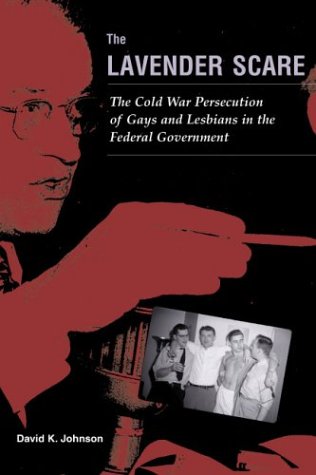
The Lavender Scare: The Cold War Persecution of Gays and Lesbians in the Federal Government

David K. Johnson (University of South Florida). The Lavender Scare (The University of Chicago Press, 2004).  

"Warning of a spreading homosexual menace, McCarthy and his Republican allies introduced 'moral values' into the American political arsenal and helped win back the White House after twenty years of Democratic control. Drawing on newly declassified documents and interviews with former government officials, Johnson chronicles how the myth that homosexuals threatened national security ruined thousands of lives and pushed many to suicide."
The Lavender Scare book jacket

Friday, April 4, 2014

License to Wed: What Legal Marriage Means to Same-Sex Couples

Kimberly D. Richman (University of San Francisco). License to Wed (New York University Press, 2014). 

"This book examines the meanings of marriage for couples in the two first states that extended that right to same-sex couples: California and Massachusetts. The two states provide a compelling contrast: while in California the rights that go with marriageinheritance, custody, and so forthhad already been granted to couples under the state's domestic partnership law, couples in Massachusetts did not previously have this same set of rights.  And while Massachusetts has offered civil marriage consistently since 2004, Californians have experienced a much more turbulent legal path.  And yet, same-sex couples in both states seek to marry for a variety of interacting, overlapping, and evolving reasons that do not vary significantly by location."
License to Wed book jacket

Thursday, February 20, 2014

The Geography of Love: Same-sex Marriage & Relationship Recognition in America (The Story in Maps)

Peter Nicolas & Mark Strong (University of Washington).  The Geography of Love, Third Edition (2013).

"With 15 years' experience as a geographic-information systems or mapping specialist, Strong scoured census records and maps for information that brought election results and gay rights together.  Nicolas, meanwhile, brought his legal mind to what was an exhaustive research effort, as well as a bit of insider knowledge. In 1992, as a 21-year-old graduate student at the University of Michigan, he was elected to the Ann Arbor City Council and voted on an ordinance extending domestic-partner benefits to city employees. As a law professor who teaches a class each year on GLBT rights and the constitution, Nicolas said he found domestic partnership registries in places 'where you didn't think they existed.'"
 —Lornet Turnbull, Seattle Times