Alison L. Gash (University of Oregon). Below the Radar: How Silence can Save Civil Rights (Oxford University Press, 2015).
 "Drawing from interviews with advocates and opponents, the book introduces readers to two sets of civil rights battles in which advocates devised strategies to remain 'under the radar' and away from the prying eyes of a volatile public. In so doing they diminished both the incidence and influence of backlash. Advocates working on behalf of lesbian and gay parents relied on lower court rulings, family law, and less polarizing frames to advance custody and co-parenting requests without attracting the attention of the 'family values' groups and voters who had swiftly barred marriage equality. Those working on behalf of individuals with disabilities hoping to live in community-based group housing delayed notifying zoning boards and neighbors of their intention to reside in single-family neighborhoods until after their property was secured in order to minimize NIMBY-induced housing impediments. This study of low-visibility advocacy offers a lens on an underexplored and underestimated source of policy reform."
—Publisher's website
"Drawing from interviews with advocates and opponents, the book introduces readers to two sets of civil rights battles in which advocates devised strategies to remain 'under the radar' and away from the prying eyes of a volatile public. In so doing they diminished both the incidence and influence of backlash. Advocates working on behalf of lesbian and gay parents relied on lower court rulings, family law, and less polarizing frames to advance custody and co-parenting requests without attracting the attention of the 'family values' groups and voters who had swiftly barred marriage equality. Those working on behalf of individuals with disabilities hoping to live in community-based group housing delayed notifying zoning boards and neighbors of their intention to reside in single-family neighborhoods until after their property was secured in order to minimize NIMBY-induced housing impediments. This study of low-visibility advocacy offers a lens on an underexplored and underestimated source of policy reform."
—Publisher's website
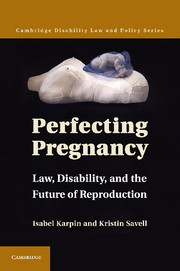
Isabel Karpin & Kristin Savell (University of Sydney), Perfecting Pregnancy: Law, Disability, and the Future of Reproduction (University of Cambridge Press, 2014).
"Prenatal and preimplantation testing technologies have offered unprecedented access to information about the genetic and congenital makeup of our prospective progeny. Future developments such as preconception testing, noninvasive prenatal testing, and more extensive preimplantation testing promise to increase that access further still. . . . The overwhelming question for legislators has been whether and, if so, how to regulate the use of these technologies in the face of compelling but seemingly contradictory claims about the advancement of reproductive choice and the dangers of eugenic or discriminatory effects."
—Publisher's website
Allison C. Carey & Liat Ben-Moshe (eds.). Disability Incarcerated (Palgrave Macmillan, 2014).
"Disability Incarcerated gathers thirteen contributions from an impressive array of fields. Taken together, these essays assert that a complex understanding of disability is crucial to an understanding of incarceration, and that we must expand what has come to be called 'incarceration.' The chapters in this book examine a host of sites, such as prisons, institutions for people with developmental disabilities, psychiatric hospitals, treatment centers, special education, detention centers, and group homes; explore why various sites should be understood as incarceration; and discuss the causes and effects of these sites historically and currently."
—Publisher's website
 "Drawing from interviews with advocates and opponents, the book introduces readers to two sets of civil rights battles in which advocates devised strategies to remain 'under the radar' and away from the prying eyes of a volatile public. In so doing they diminished both the incidence and influence of backlash. Advocates working on behalf of lesbian and gay parents relied on lower court rulings, family law, and less polarizing frames to advance custody and co-parenting requests without attracting the attention of the 'family values' groups and voters who had swiftly barred marriage equality. Those working on behalf of individuals with disabilities hoping to live in community-based group housing delayed notifying zoning boards and neighbors of their intention to reside in single-family neighborhoods until after their property was secured in order to minimize NIMBY-induced housing impediments. This study of low-visibility advocacy offers a lens on an underexplored and underestimated source of policy reform."