Showing posts with label Free speech. Show all posts

Friday, August 30, 2019

Troublemakers: Students' Rights and Racial Justice in the Long 1960s

Kathryn Schumaker, Troublemakers: Students' Rights and Racial Justice in the Long 1960s (NYU Press, 2019)

In the late 1960s, protests led by students roiled high schools across the country. As school desegregation finally took place on a wide scale, students of color were particularly vocal in contesting the racial discrimination they saw in school policies and practices. And yet, these young people had no legal right to express dissent at school. It was not until 1969 that the Supreme Court would recognize the First Amendment rights of students in the landmark Tinker v. Des Moines case.

A series of students’ rights lawsuits in the desegregation era challenged everything from school curricula to disciplinary policies. But in casting students as “troublemakers” or as “culturally deficient,” school authorities and other experts persuaded the courts to set limits on rights protections that made students of color disproportionately vulnerable to suspension and expulsion.

Troublemakers traces the history of black and Chicano student protests from small-town Mississippi to metropolitan Denver and beyond, showcasing the stories of individual protesters and demonstrating how their actions contributed to the eventual recognition of the constitutional rights of all students. Offering a fresh interpretation of this pivotal era, Troublemakers shows that when black and Chicano teenagers challenged racial discrimination in American public schools, they helped remake American constitutional law and establish protections of free speech, due process, equal protection, and privacy for students.

Tuesday, November 22, 2016

Free Speech & Human Dignity

Steven J. Heyman (Chicago-Kent College of Law), Free Speech & Human Dignity (Yale Univ. Press 2008).


"In this important book, Steven J. Heyman presents a theory of the First Amendment that seeks to overcome the conflict between free speech and human dignity. This liberal humanist theory recognizes a strong right to freedom of expression while also providing protection against the most serious forms of assaultive speech. Heyman then uses the theory to illuminate a wide range of contemporary disputes, from flag burning and antiabortion demonstrations to pornography and hate speech." 
Publisher's description

Monday, September 12, 2016

Hate Speech and Democratic Citizenship

Eric Heinze (University of London), Hate Speech and Democratic Citizenship (Oxford Univ. Press, 2016). 


"Most modern democracies punish hate speech. Less freedom for some, they claim, guarantees greater freedom for others. Heinze rejects that approach, arguing that democracies have better ways of combating violence and discrimination against vulnerable groups without having to censor speakers. Critiquing dominant free speech theories, Heinze explains that free expression must be safeguarded not just as an individual right, but as an essential attribute of democratic citizenship. The book challenges contemporary state regulation of public discourse by promoting a stronger theory of what democracy is and what it demands. Examining US, European and international approaches, Heinze offers a new vision of free speech within Western democracies." 

Publisher's description

Thursday, April 2, 2015

Speech Matters: On Lying, Morality, and the Law

Seana Valentine Shiffrin (UCLA). Speech Matters: On Lying, Morality, and the Law (Princeton University Press, 2014).

"To understand one another as individuals and to fulfill the moral duties that require such understanding, we must communicate with each other. We must also maintain protected channels that render reliable communication possible, a demand that, Seana Shiffrin argues, yields a prohibition against lying and requires protection for free speech. This book makes a distinctive philosophical argument for the wrong of the lie and provides an original account of its difference from the wrong of deception."
Publisher's website


Tuesday, December 16, 2014

Comic Art, Creativity and the Law

Marc H. Greenberg (Golden Gate University). Comic Art, Creativity and the Law (Edward Elgar, 2014).

"The creation of works of comic art, including graphic novels, comic books, cartoons and comic strips, and political cartoons, is affected, and at times limited, by a diverse array of laws, ranging from copyright law to free speech laws. This book examines how this intersection affects the creative process, and proposes approaches that encourage, rather than limit, that process in the comic art genre. Attention to the role comic art occupies in popular culture, and how the law responds to that role, is also analyzed."
Publisher's website

Thursday, May 8, 2014

The Progeny: Justice William J. Brennan's Fight to Preserve the Legacy of New York Times v. Sullivan

Lee Levine & Stephen Wermiel. The Progeny (American Bar Association, 2014).

"New York Times Co. v. Sullivan, credited with defining the central meaning of the First Amendment, has protected the freedom of expression for the past 50 years. This compelling work of historical non-fiction focuses on the progeny of that decision, examining how Justice Brennan nurtured and developed the constitutional law of defamation and related claims.

The book draws on the previously unreported papers of Justice Brennan and several of his colleagues and, through them as well as author Stephen Wermiel's private interviews with Brennan, provides the authoritative historical account of how an important body of constitutional law came to be. The Progeny offers fresh insights with respect to both what the law means and the process by which it was formulated."

From publisher's website 

Friday, February 14, 2014

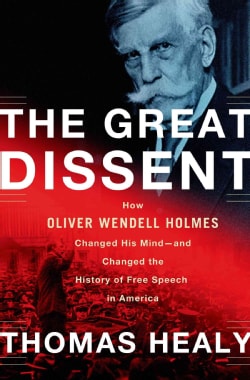
The Great Dissent: How Oliver Wendell Holmes Changes His Mind — and Changed the History of Free Speech in America

Thomas Healy (Seton Hall).  The Great Dissent (Metropolitan Books, 2013).

"Now, with the aid of newly discovered letters and confidential memos, law professor Thomas Healy reconstructs in vivid detail Holmes's journey from free-speech opponent to First Amendment hero.  It is the story of a remarkable behind-the-scenes campaign by a group of progressives to bring a legal icon to their way of thinking—and a deeply touching human narrative of an old man saved from his loneliness and despair by a few unlikely young friends."

The Great Dissent book jacket