Showing posts with label Democracy. Show all posts

Wednesday, May 1, 2019

Democracy and Dysfunction

Sanford Levinson (University of Texas Law School) and Jack M. Balkin (Yale Law School), Democracy and Dysfunction (The University of Chicago Press 2019).


Democracy and Dysfunction is a conversation between two of the leading constitutional law scholars of our time, Sanford Levinson and Jack M. Balkin, who seek to uncover the underlying causes of our current difficulties and the best way to reform American democracy. In a series of letters exchanged over a period of two years, Levinson and Balkin travel through the convulsions of the 2016 election and Trump's first year in office. They disagree about the scope of the crisis and the remedy required. Levinson believes that our Constitution is fundamentally defective and argues for a new constitutional convention. Balkin, who believes we are suffering from constitutional rot, argues that there are less radical solutions.”

Publisher’s description

Tuesday, December 20, 2016

Founding Acts: Constitutional Origins in a Democratic Age

Serdar Tekin (Ege University), Founding Acts: Constitutional Origins in a Democratic Age (Univ. of Pennsylvania 2016).


"Founding Acts explores the relationship between constitutional claims of popular sovereignty and the practice of constitution-making in our pluralistic age. Serdar Tekin argues that the process of making a constitution, or its pedigree, is as morally and politically significant as its content. Consequently, democratic constitution-making is not only about making a democratic constitution but also about making it, as much as possible, democratically.

Tekin develops two overarching arguments in support of this claim. First, citizen participation in the process of constitution-making is essential to the democratic legitimacy of a new constitution. Second, collective action, that is, the political experience of constructing public life together, is what binds diverse people into a democratic peoplehood. Bringing into dialogue a wide range of canonical and contemporary thinkers, Tekin examines historical realities extending from revolutionary America and France to contemporary South Africa and Germany." 

Publisher's description

Monday, September 12, 2016

Hate Speech and Democratic Citizenship

Eric Heinze (University of London), Hate Speech and Democratic Citizenship (Oxford Univ. Press, 2016). 


"Most modern democracies punish hate speech. Less freedom for some, they claim, guarantees greater freedom for others. Heinze rejects that approach, arguing that democracies have better ways of combating violence and discrimination against vulnerable groups without having to censor speakers. Critiquing dominant free speech theories, Heinze explains that free expression must be safeguarded not just as an individual right, but as an essential attribute of democratic citizenship. The book challenges contemporary state regulation of public discourse by promoting a stronger theory of what democracy is and what it demands. Examining US, European and international approaches, Heinze offers a new vision of free speech within Western democracies." 

Publisher's description

Monday, March 16, 2015

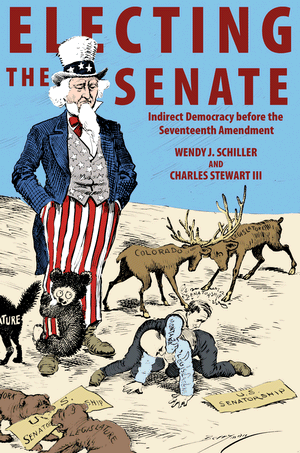
Electing the Senate: Indirect Democracy before the Seventeenth Amendment

Wendy J. Schiller (Brown University) & Charles Stewart III (Massachusetts Institute of Technology). Electing the Senate: Indirect Democracy before the Seventeenth Amendment (Princeton University Press, 2014).

"From 1789 to 1913, U.S. senators were not directly elected by the people—instead the Constitution mandated that they be chosen by state legislators. This radically changed in 1913, when the Seventeenth Amendment to the Constitution was ratified, giving the public a direct vote. Electing the Senate investigates the electoral connections among constituents, state legislators, political parties, and U.S. senators during the age of indirect elections. Wendy Schiller and Charles Stewart find that even though parties controlled the partisan affiliation of the winning candidate for Senate, they had much less control over the universe of candidates who competed for votes in Senate elections and the parties did not always succeed in resolving internal conflict among their rank and file. Party politics, money, and personal ambition dominated the election process, in a system originally designed to insulate the Senate from public pressure."

Publisher's website