Showing posts with label Comparative law. Show all posts

Wednesday, April 26, 2017

Boundaries of Loyalty: Testimony against Fellow Jews in Non-Jewish Courts

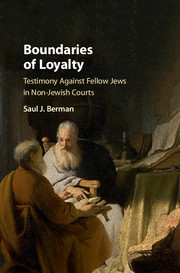
Saul J. Berman (Yeshiva University), Boundaries of Loyalty: Testimony against Fellow Jews in Non-Jewish Courts (Cambridge Univ. Press 2017). 

"Talmudic legislation prescribed penalty for a Jew to testify in a non-Jewish court, against a fellow Jew, to benefit a gentile - for breach of a duty of loyalty to a fellow Jew. Through close textual analysis, Saul Berman explores how Jewish jurists responded when this virtue of loyalty conflicted with values such as Justice, avoidance of desecration of God's Name, deterrence of crime, defence of self, protection of Jewish community, and the duty to adhere to Law of the Land. Essential for scholars and graduate students in Talmud, Jewish law and comparative law, this key volume details the nature of these loyalties as values within the Jewish legal system, and how the resolution of these conflicts was handled. Berman additionally explores why this issue has intensified in contemporary times and how the related area of 'Mesirah' has wrongfully come to be prominently associated with this law regulating testimony."

Publisher's description

Thursday, February 9, 2017

The Purse and the Sword

Daniel Friedmann, The Purse and the Sword: The Trials of Israel's Legal Revolution (Oxford Univ. Press 2016).

"The Purse and the Sword presents a critical analysis of Israel's legal system in the context of its politics, history, and the forces that shape its society. This book examines the extensive powers that Israel's Supreme Court arrogated to itself since the 1980s and traces the history of the transformation of its legal system and the shifts in the balance of power between the branches of government. Centrally, this shift has put unprecedented power in the hands of both the Court and Israel's attorney general and state prosecution at the expense of Israel's cabinet, constituting its executive branch, and the Knesset--its parliament. . . . the aggrandizement of power by the legal system led to a backlash against the Supreme Court in the early part of the current century, and to the partial rebalancing of power towards the political branches."

From publisher's description

Thursday, January 26, 2017

Privacy Revisited


Ronald J. Krotoszynski, Jr. (Univ. of Alabama), Privacy Revisited: A Global Perspective on the Right to Be Left Alone (Oxford Univ. Press 2016). 

"Rapid technological change, the advent of Big Data, and the creation of society-wide government surveillance programs have transformed the accessibility of highly personal information; these developments have highlighted the ambiguous treatment of privacy and personal intimacy. National legal systems vouchsafe and define 'privacy,' and its first cousin 'dignity,' in different ways that reflect local legal and cultural values. Yet, in an increasingly globalized world, purely local protection of privacy interests may prove insufficient to safeguard effectively fundamental autonomy interests - interests that lie at the core of self-definition, personal autonomy, and freedom." 
Publisher's description

Monday, September 12, 2016

Hate Speech and Democratic Citizenship

Eric Heinze (University of London), Hate Speech and Democratic Citizenship (Oxford Univ. Press, 2016). 


"Most modern democracies punish hate speech. Less freedom for some, they claim, guarantees greater freedom for others. Heinze rejects that approach, arguing that democracies have better ways of combating violence and discrimination against vulnerable groups without having to censor speakers. Critiquing dominant free speech theories, Heinze explains that free expression must be safeguarded not just as an individual right, but as an essential attribute of democratic citizenship. The book challenges contemporary state regulation of public discourse by promoting a stronger theory of what democracy is and what it demands. Examining US, European and international approaches, Heinze offers a new vision of free speech within Western democracies." 

Publisher's description

Tuesday, January 20, 2015

Judicial Review of National Security

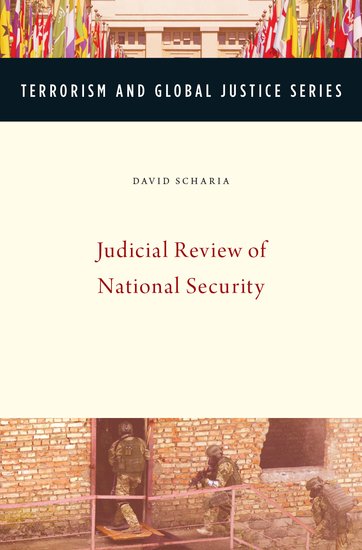
David Scharia. Judicial Review of National Security (Oxford University Press, 2014).

"In Judicial Review of National Security, David Scharia explains how the Supreme Court of Israel developed unconventional judicial review tools and practices that allowed it to provide judicial guidance to the Executive in real-time. In this book, he argues that courts could play a much more dominant role in reviewing national security, and demonstrates the importance of intensive real-time inter-branch dialogue with the Executive, as a tool used by the Israeli Court to provide such review. This book aims to show that if one Supreme Court was able to provide rigorous judicial review of national security in real-time, then we should reconsider the conventional wisdom regarding the limits of judicial review of national security."
—Publisher's website

Thursday, December 18, 2014

Comparative Matters: The Renaissance of Comparative Constitutional Law

Ran Hirschl (University of Toronto). Comparative Matters (Oxford University Press, 2014).

"Through an extensive exploration of comparative constitutional endeavours past and present, near and far, Hirschl shows how attitudes towards engagement with the constitutive laws of others reflect tensions between particularism and universalism as well as competing visions of who 'we' are as a political community. Drawing on insights from social theory, religion, history, political science, and public law, Hirschl argues for an interdisciplinary approach to comparative constitutionalism that is methodologically and substantively preferable to merely doctrinal accounts. The future of comparative constitutional studies, he contends, lies in relaxing the sharp divide between constitutional law and the social sciences."
Publisher's website