 Norman S. Poser (Brooklyn Law School). Lord Mansfield: Justice in the Age of Reason (McGill-Queen's University Press, 2013).
"Mr. Poser offers us a fascinating portrait.
Awarded an earldom by George III, Mansfield was a typical 18th-century
grandee, ruthlessly ambitious and casually venal. His career made him
extremely rich, and his guarded political style often appeared
unscrupulously calculated to accelerate his own advancement. But his
mind was extraordinary, and he worked with legendary intensity. . . . Mansfield's judgments
ingrained themselves into the legal culture of the English-speaking
world. Modern rules governing the use of expert testimony, for instance,
trace to Mansfield. The U.S. Supreme Court, Mr. Poser informs
us, has cited Mansfield more than 300 times, on issues from defamation
to parental rights."
—Jeffrey Collins
Norman S. Poser (Brooklyn Law School). Lord Mansfield: Justice in the Age of Reason (McGill-Queen's University Press, 2013).
"Mr. Poser offers us a fascinating portrait.
Awarded an earldom by George III, Mansfield was a typical 18th-century
grandee, ruthlessly ambitious and casually venal. His career made him
extremely rich, and his guarded political style often appeared
unscrupulously calculated to accelerate his own advancement. But his
mind was extraordinary, and he worked with legendary intensity. . . . Mansfield's judgments
ingrained themselves into the legal culture of the English-speaking
world. Modern rules governing the use of expert testimony, for instance,
trace to Mansfield. The U.S. Supreme Court, Mr. Poser informs
us, has cited Mansfield more than 300 times, on issues from defamation
to parental rights."
—Jeffrey Collins
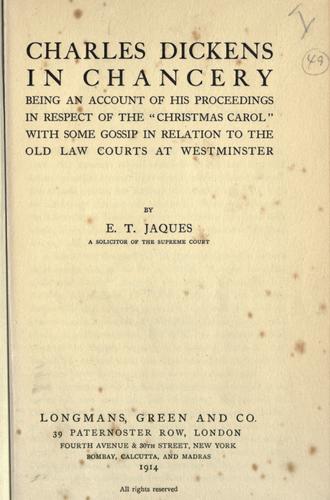 E.T. Jacques. Charles Dickens in Chancery: Being an Account of his Proceedings in Respect of the "Christmas Carol" with Some Gossip in Relation to the Old Law Courts at Westminster (Longmans, Green and Co., 1914).
An account of Dickens' successful lawsuit against publishers who copied and sold A Christmas Carol (retitled as "A Christmas Ghost Story") without permission. The appendix includes the original pleadings as well as newspaper articles relating to the case.
Stephen M. Feldman (University of Wyoming). Please Don't Wish Me a Merry Christmas (New York University Press, 1997).
"In Please Don't Wish Me a Merry Christmas,
Stephen M. Feldman . . . argues that
the separation of church and state primarily manifests and reinforces
Christian domination in American society. Furthermore, Feldman reveals
that the separation of church and state did not first arise in the
United States. Rather, it has slowly evolved as a political and
religious development through western history, beginning with the
initial appearance of Christianity as it contentiously separated from
Judaism."
—Publisher's website
Lucas Hilderbrand (UC Irvine). Inherent Vice: Bootleg Histories of Videotape and Copyright (Duke University Press, 2009).
“By taking up the theme of analog videotape bootlegging in an era of
aggressive digital rights management, Lucas Hilderbrand provides a
timely and important window on the issues at stake in the creative
commons movement. At the same time, he makes extremely interesting and
valuable contributions to scholarship on the aesthetics of new media
through his explorations of the affective dimensions of videotape, the
implications of its ephemeral quality, and the interactivity its new
technologies enabled.”
—Timothy Lenoir, Duke University
Nancy S. Kim (California Western). Wrap Contracts: Foundations and Ramifications (Oxford University Press, 2013).
"[Nancy Kim] explains how businesses and existing law unfairly burden users and create a coercive contracting environment that forces users to 'accept' in order to participate in modern life. Kim's central thesis is that how a contract is presented affects and reveals the intent of the parties. She proposes doctrinal solutions to fairly balance the burdens of wrap contracts between businesses and consumers."
—Wrap Contracts book jacket
 Norman S. Poser (Brooklyn Law School). Lord Mansfield: Justice in the Age of Reason (McGill-Queen's University Press, 2013).


