Showing posts with label Business Law. Show all posts

Monday, September 30, 2019

White Shoe: How a New Breed of Wall Street Lawyers Changed Big Business and the American Century

John Oller, White Shoe: How a New Breed of Wall Street Lawyers Changed Big Business and the American Century (Dutton, 2019).

The legal profession once operated on a smaller scale -- folksy lawyers arguing for fairness and justice before a judge and jury. But by year 1900, a new type of lawyer had been born, one who understood business as well as the law. Working hand in glove with their clients, over the next two decades these New York City "white shoe" lawyers devised and implemented legal strategies that would drive the business world throughout the twentieth century. These lawyers were the architects of the new monopolistic corporations so despised by many, and they acted as guardians who helped the kings of industry fend off government overreaching. Yet they also quietly steered their robber baron clients away from a "public be damned" attitude toward more enlightened corporate behavior during a period of progressive, turbulent change in America.

Author John Oller, himself a former Wall Street lawyer, gives us a richly written glimpse of turn-of-the-century New York, from the grandeur of private mansions and elegant hotels to the city's early skyscrapers and transportation systems and the depths of its deplorable tenement housing conditions. Some of the biggest names of the era are featured, including business titans J. P. Morgan and John D. Rockefeller; lawyer statesmen Elihu Root and Charles Evans Hughes; and presidents Theodore Roosevelt, William Howard Taft, and Woodrow Wilson.
-Publisher's Description

Friday, April 5, 2019

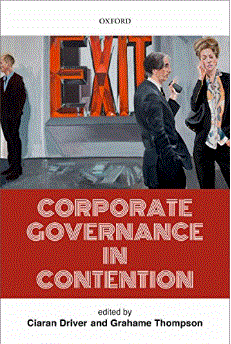
Corporate Governance in Contention

Ciaran Driver (University of London) & Grahame Thompson (Open University, UK), Corporate Governance in Contention (Oxford University Press 2018).


Corporate governance is a complex idea that is often inappropriately simplified as a cookbook of recommended measures to improve financial performance. Meta studies of published research show that the supposed benign effects of these measures - independent directors or highly incentivised executives - are at best context-specific. There is thus a challenge to explain the meaning, purpose, and importance of corporate governance. This volume addresses these issues. The issues discussed centre on relationships within the firm e.g. between labour, managers, and investors, and relationships outside the firm that affect consumers or the environment.

The essays in this collection are the considered selection by the editors and the contributors themselves of what are seen as some of the most weighty and urgent issues that connect the corporation and society at large in developed economies with established property rights. The essays are to be read in dialogue with each other, giving a richer understanding than could be obtained by shepherding all contributions into a single mould. Nevertheless taken together they demonstrate a shared sense of deep concern that the corporate governance agenda has been and still is on the wrong track. The contributors, individually and collectively, identify in this compendium both a research programme and a platform for change.
-Publisher's description