Harry G. Frankfurt (Princeton University), On Inequality (Princeton University Press, 2015).
 "In this provocative book, the #1 New York Times bestselling author of On Bullshit presents a compelling and unsettling response to those who believe that the goal of social justice should be economic equality or less inequality. Harry Frankfurt, one of the most influential moral philosophers in the world, argues that we are morally obligated to eliminate poverty—not achieve equality or reduce inequality. Our focus should be on making sure everyone has a sufficient amount to live a decent life. To focus instead on inequality is distracting and alienating.
At the same time, Frankfurt argues that the conjunction of vast wealth and poverty is offensive. If we dedicate ourselves to making sure everyone has enough, we may reduce inequality as a side effect. But it’s essential to see that the ultimate goal of justice is to end poverty, not inequality."
—Publisher's description
Kevin Roose. Young Money (Grand Central Publishing, 2014).
"Becoming a young Wall Street banker is like pledging the world's most lucrative and soul-crushing fraternity. Every year, thousands of eager college graduates are hired by the world's financial giants, where they're taught the secrets of making obscene amounts of money—as well as how to dress, talk, date, drink, and schmooze like real financiers. . . . Roose's Young bankers are exposed to the exhausting workloads, huge bonuses, and recreational drugs that have always characterized Wall Street life. But they experience something new, too: an industry forever changed by the massive financial collapse of 2008. And as they get their Wall Street educations, they face hard questions about morality, prestige, and the value of their work."
—Young Money book jacket
 Richard S. Grossman (Wesleyan University). WRONG (Oxford University Press, 2013).
"WRONG examines nine of the worst economic policy blunders of the last 250 years in order to learn why these policies were adopted and how they went so wrong. Analyzing events as diverse as trade policy in the 18th century, famine relief policy in the 19th century, post-war reconstruction in the 20th century, and the subprime and sovereign debt crises in the 21st century, WRONG presents detailed post-mortem analyses of some of the world's most severe economic policy failures. The issues that underlie these historical crises—famine, post-war reconstruction, global trade, and international finance, to name a few—remain extremely relevant today. . . . Presented clearly for economists and non-economists alike, WRONG provides a valuable guide book for contemporary policy makers and the citizens who elect them."
—WRONG book jacket
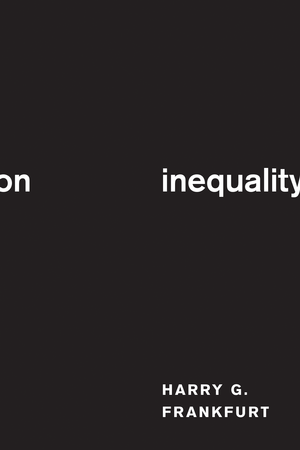 "In this provocative book, the #1 New York Times bestselling author of On Bullshit presents a compelling and unsettling response to those who believe that the goal of social justice should be economic equality or less inequality. Harry Frankfurt, one of the most influential moral philosophers in the world, argues that we are morally obligated to eliminate poverty—not achieve equality or reduce inequality. Our focus should be on making sure everyone has a sufficient amount to live a decent life. To focus instead on inequality is distracting and alienating.

