Showing posts with label Innovation. Show all posts

Monday, September 30, 2019

Slices & Lumps: Division and Aggregation in Law and Life

Lee Anne Fennell, Slices and Lumps: Division and Aggregation in Law and Life (University of Chicago Press, 2019).

How things are divided up or pieced together matters. Half a bridge is of no use at all. Conversely, many things would do more good if they could be divided up differently: Perhaps you would prefer a job that involves a third fewer hours and a third less pay or a car that materializes only when needed and is priced accordingly? Difficulties in "slicing" and "lumping" shape nearly every facet of how we live and work -- and a great deal of law and policy as well.

Lee Anne Fennell explores how both types of challenges -- carving out useful slices and assembling useful lumps -- surface in myriad contexts, from hot-button issues like conservation and eminent domain to developments in the sharing economy to personal struggles over work, money, time, diet and exercise. Yet the significance of configuration is often overlooked, leading to missed opportunities for improving our lives. With a technology-fueled entrepreneurial explosion under way that is dividing goods, services, and jobs in novel ways, and as urbanization and environmental threats raise the stakes for assembling resources and cooperation, this is an especially exciting and crucial time to confront questions of slicing and lumping. The future of the city, the workplace, the marketplace, and the environment all turn on matters of configuration, as do the prospects for more effective legal doctrines, for better management of finances and health, and more. This book reveals configuration's power and potential -- as a unifying concept and as a focus of public and private innovation.
-Publisher's Description

Friday, August 2, 2019

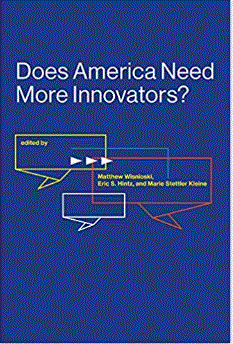
Does America Need More Innovators?

Matthew Wisnioski (Virginia Tech) ed., Does America Need More Innovators? (MIT Press 2019).


A critical exploration of today's global imperative to innovate, by champions, critics, and reformers of innovation.
Corporate executives, politicians, and school board leaders agree―Americans must innovate. Innovation experts fuel this demand with books and services that instruct aspiring innovators in best practices, personal habits, and workplace cultures for fostering innovation. But critics have begun to question the unceasing promotion of innovation, pointing out its gadget-centric shallowness, the lack of diversity among innovators, and the unequal distribution of innovation's burdens and rewards. Meanwhile, reformers work to make the training of innovators more inclusive and the outcomes of innovation more responsible. This book offers an overdue critical exploration of today's global imperative to innovate by bringing together innovation's champions, critics, and reformers in conversation.
The book presents an overview of innovator training, exploring the history, motivations, and philosophies of programs in private industry, universities, and government; offers a primer on critical innovation studies, with essays that historicize, contextualize, and problematize the drive to create innovators; and considers initiatives that seek to reform and reshape what it means to be an innovator.

- Publisher's description                          

Tuesday, October 14, 2014

Powers of Two: Finding the Essence of Innovation in Creative Pairs

Joshua Wolf Shenk. Powers of Two: Finding the Essence of Innovation in Creative Pairs (Houghton Mifflin Harcourt, 2014).

"Society has long romanticised the creative power of the loner, be it the scientist who works all night in a laboratory or the cloistered writer wrapped up in the world of his own imagination. 'For centuries the myth of the lone genius has towered over us like a colossus,' writes Joshua Wolf Shenk at the start of his new book, Powers of Two. Unimpressed, he tries to debunk the idea that 'world-changing things' come from single minds, and makes the controversial claim that it is the 'creative pair', rather than the individual, that has produced the most imaginative work in history."
The Economist