Calvin Trillin, Jackson, 1964 (Penguin Random House, 2016).
"From bestselling author and beloved New Yorker writer Calvin Trillin, a deeply resonant, career-spanning collection of articles on race and racism, from the 1960s to the present.
In the early sixties, Calvin Trillin got his start as a journalist covering the Civil Rights Movement in the South. Over the next five decades of reporting, he often returned to scenes of racial tension. Now, for the first time, the best of Trillin’s pieces on race in America have been collected in one volume."
—Publisher's description
Cathryn Costello (Oxford), The Human Rights of Migrants and Refugees in European Law (Oxford Univ. Press 2016).
"Focusing on access to territory and authorization of presence and residence for third-country nationals, this book examines the EU law on immigration and asylum, addressing related questions of security of residence. Concentrating on the key measures concerning both the rights of third-country nationals to enter and stay in the EU, and the EU's construction of illegal immigration, it provides a detailed and critical discussion of EU and ECHR migration and refugee law."
—Publisher's description
Jeffrey Rosen (George Washington University Law School), Louis D. Brandeis: American Prophet (Yale Univ. Press 2016).

"According to Jeffrey Rosen, Louis D. Brandeis was 'the Jewish Jefferson,' the greatest critic of what he called 'the curse of bigness,' in business and government, since the author of the Declaration of Independence. Published to commemorate the hundredth anniversary of his Supreme Court confirmation on June 1, 1916, Louis D. Brandeis: American Prophet argues that Brandeis was the most farseeing constitutional philosopher of the twentieth century. In addition to writing the most famous article on the right to privacy, he also wrote the most important Supreme Court opinions about free speech, freedom from government surveillance, and freedom of thought and opinion. And as the leader of the American Zionist movement, he convinced Woodrow Wilson and the British government to recognize a Jewish homeland in Palestine. Combining narrative biography with a passionate argument for why Brandeis matters today, Rosen explores what Brandeis, the Jeffersonian prophet, can teach us about historic and contemporary questions involving the Constitution, monopoly, corporate and federal power, technology, privacy, free speech, and Zionism."
—Publisher's Description
Marie A. Failinger (Mitchell Hamline School of Law) & Ezra Rosser (American University) (eds.), The Poverty Law Canon (Univ. of Michigan Press 2016).
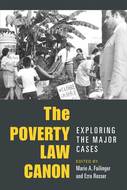 "The Poverty Law Canon takes readers into the lives of the clients and lawyers who brought critical poverty law cases in the United States. These cases involved attempts to establish the right to basic necessities, as well as efforts to ensure dignified treatment of welfare recipients and to halt administrative attacks on federal program benefit levels. They also confronted government efforts to constrict access to justice, due process, and rights to counsel in child support and consumer cases, social welfare programs, and public housing. By exploring the personal narratives that gave rise to these lawsuits as well as the behind-the-scenes dynamics of the Supreme Court, the text locates these cases within the social dynamics that shaped the course of litigation."
—Publisher's description
"The Poverty Law Canon takes readers into the lives of the clients and lawyers who brought critical poverty law cases in the United States. These cases involved attempts to establish the right to basic necessities, as well as efforts to ensure dignified treatment of welfare recipients and to halt administrative attacks on federal program benefit levels. They also confronted government efforts to constrict access to justice, due process, and rights to counsel in child support and consumer cases, social welfare programs, and public housing. By exploring the personal narratives that gave rise to these lawsuits as well as the behind-the-scenes dynamics of the Supreme Court, the text locates these cases within the social dynamics that shaped the course of litigation."
—Publisher's description
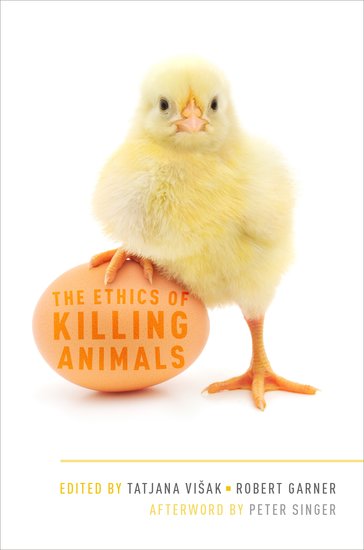 Tatjana Visak & Robert Garner (eds.), The Ethics of Killing Animals (Oxford Univ. Press 2015).
"While it is generally accepted that animal welfare matters morally, it is less clear how to morally evaluate the ending of an animal's life. It seems to matter for the animal whether it experiences pain or pleasure, or enjoyment or suffering. But does it also matter for the animal whether it lives or dies? Is a longer life better for an animal than a shorter life? If so, under what conditions is this so, and why is this the case? Is it better for an animal to live rather than never to be born at all? The Ethics of Killing Animals addresses these value-theoretical questions about animal life, death and welfare. It also discusses whether and how answers to these questions are relevant for our moral duties towards animals."
—Publisher's description


