Justice John Paul Stevens, The Making of a Justice: Reflections on My First 94 Years (Little, Brown & Co., 2019).
When Justice John Paul Stevens retired from the Supreme Court of the United States in 2010, he left a legacy of service unequaled in the history of the Court. During his thirty-four-year tenure, Justice Stevens was a prolific writer, authoring in total more than a thousand opinions. In The Making of a Justice, he recounts the first ninety-four years of his extraordinary life, offering an intimate and illuminating account of his service on the nation's highest court.
Appointed by President Ford and eventually retiring during President Obama's first term, Justice Stevens has been witness to, and an integral part of, landmark changes in American society.
With stories of growing up in Chicago, his work as a naval traffic analyst at Pearl Harbor during World War II, and his early days in private practice, as well as a behind-the-scenes look at some of the most important Supreme Court decisions over the past four decades, The Making of a Justice offers a warm and fascinating account of Justice Stevens's unique and transformative life. This comprehensive memoir is a must-read for those trying to better understand our country and the Constitution.
-Publisher's description
Sunday, July 28, 2019
Wednesday, July 24, 2019
Misdemeanorland
Issa Kohler-Hausmann, Misdemeanorland (Princeton University Press, 2019).
Felony conviction and mass incarceration attract considerable media attention these days, yet the most common criminal-justice encounters are for misdemeanors, not felonies, and the most common outcome is not prison. In the early 1990s, New York City launched an initiative under the banner of Broken Windows policing to dramatically expand enforcement against low-level offenses. Misdemeanorland is the first book to document the fates of hundreds of thousands of people hauled into lower criminal courts as part of this policing experiment.
Drawing on three years of fieldwork inside and outside of the courtroom, in-depth interviews, and analysis of trends in arrests and dispositions of misdemeanors going back three decades, Issa Kohler-Hausmann argues that lower courts have largely abandoned the adjudicative model of criminal law administration in which questions of factual guilt and legal punishment drive case outcomes. Due to the sheer volume of arrests, lower courts have adopted a managerial model—and the implications are troubling. Kohler-Hausmann shows how significant volumes of people are marked, tested, and subjected to surveillance and control even though about half the cases result in some form of legal dismissal. She describes in harrowing detail how the reach of America's penal state extends well beyond the shocking numbers of people incarcerated in prisons or stigmatized by a felony conviction.
Revealing and innovative, Misdemeanorland shows how the lower reaches of our criminal justice system operate as a form of social control and surveillance, often without adjudicating cases or imposing formal punishment.
- Publisher's description
Felony conviction and mass incarceration attract considerable media attention these days, yet the most common criminal-justice encounters are for misdemeanors, not felonies, and the most common outcome is not prison. In the early 1990s, New York City launched an initiative under the banner of Broken Windows policing to dramatically expand enforcement against low-level offenses. Misdemeanorland is the first book to document the fates of hundreds of thousands of people hauled into lower criminal courts as part of this policing experiment.Drawing on three years of fieldwork inside and outside of the courtroom, in-depth interviews, and analysis of trends in arrests and dispositions of misdemeanors going back three decades, Issa Kohler-Hausmann argues that lower courts have largely abandoned the adjudicative model of criminal law administration in which questions of factual guilt and legal punishment drive case outcomes. Due to the sheer volume of arrests, lower courts have adopted a managerial model—and the implications are troubling. Kohler-Hausmann shows how significant volumes of people are marked, tested, and subjected to surveillance and control even though about half the cases result in some form of legal dismissal. She describes in harrowing detail how the reach of America's penal state extends well beyond the shocking numbers of people incarcerated in prisons or stigmatized by a felony conviction.
Revealing and innovative, Misdemeanorland shows how the lower reaches of our criminal justice system operate as a form of social control and surveillance, often without adjudicating cases or imposing formal punishment.
- Publisher's description
Friday, July 19, 2019
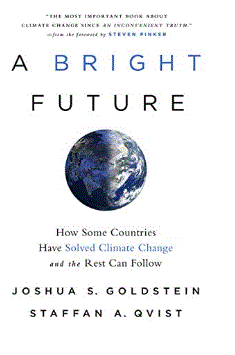
A Bright Future: How Some Countries Have Solved Climate Change and the Rest Can Follow
Joshua S. Goldstein & Steffan A. Qvist, A Bright Future: How Some Countries Have Solved Climate Change and the Rest Can Follow (2019).
As climate change quickly approaches a series of turning points that guarantee disastrous outcomes, a solution is hiding in plain sight. Several countries have already replaced fossil fuels with low-carbon energy sources, and done so rapidly, in one to two decades. By following their methods, we could decarbonize the global economy by midcentury, replacing fossil fuels even while world energy use continues to rise. But so far we have lacked the courage to really try.
In this clear-sighted and compelling book, Joshua Goldstein and Staffan Qvist explain how clean energy quickly replaced fossil fuels in such places as Sweden, France, South Korea, and Ontario. Their people enjoyed prosperity and growing energy use in harmony with the natural environment. They didn't do this through personal sacrifice, nor through 100 percent renewables, but by using them in combination with an energy source the Swedes call kärnkraft, hundreds of times safer and cleaner than coal.
Clearly written and beautifully illustrated, yet footnoted with extensive technical references, Goldstein and Qvist's book will provide a new touchstone in discussions of climate change. It could spark a shift in world energy policy that, in the words of Steven Pinker's foreword, literally saves the world.
As climate change quickly approaches a series of turning points that guarantee disastrous outcomes, a solution is hiding in plain sight. Several countries have already replaced fossil fuels with low-carbon energy sources, and done so rapidly, in one to two decades. By following their methods, we could decarbonize the global economy by midcentury, replacing fossil fuels even while world energy use continues to rise. But so far we have lacked the courage to really try.
In this clear-sighted and compelling book, Joshua Goldstein and Staffan Qvist explain how clean energy quickly replaced fossil fuels in such places as Sweden, France, South Korea, and Ontario. Their people enjoyed prosperity and growing energy use in harmony with the natural environment. They didn't do this through personal sacrifice, nor through 100 percent renewables, but by using them in combination with an energy source the Swedes call kärnkraft, hundreds of times safer and cleaner than coal.
Clearly written and beautifully illustrated, yet footnoted with extensive technical references, Goldstein and Qvist's book will provide a new touchstone in discussions of climate change. It could spark a shift in world energy policy that, in the words of Steven Pinker's foreword, literally saves the world.
- Publisher's description
Friday, July 12, 2019
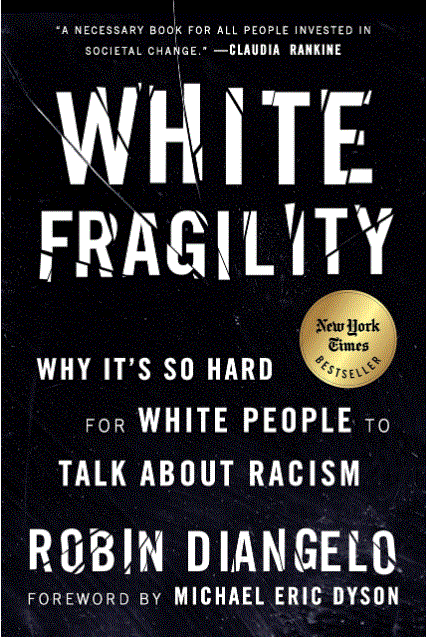
White Fragility: Why It's So Hard for White People to Talk About Racism
Robin DiAngelo, White Fragility: Why It's So Hard for White People to Talk About Racism (Beacon Press 2018).
The New York Times best-selling book exploring the
counterproductive reactions white people have when their assumptions about race
are challenged, and how these reactions maintain racial inequality.
In this
“vital, necessary, and beautiful book” (Michael Eric Dyson), antiracist
educator Robin DiAngelo deftly illuminates the phenomenon of white fragility
and “allows us to understand racism as a practice not restricted to ‘bad
people’ (Claudia Rankine). Referring to the defensive moves that white people
make when challenged racially, white fragility is characterized by emotions
such as anger, fear, and guilt, and by behaviors including argumentation and silence.
These behaviors, in turn, function to reinstate white racial equilibrium and
prevent any meaningful cross-racial dialogue. In this in-depth exploration,
DiAngelo examines how white fragility develops, how it protects racial
inequality, and what we can do to engage more constructively.
- Publisher's description
Friday, July 5, 2019
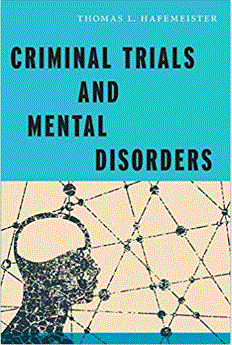
Criminal Trials and Mental Disorders
Thomas L. Hafemeister, Criminal Trials and Mental Disorders (New York University Press 2019).
The complicated relationship between defendants with mental
health disorders and the criminal justice system
The American criminal justice
system is based on the bedrock principles of fairness and justice for all. In
striving to ensure that all criminal defendants are treated equally under the
law, it endeavors to handle similar cases in similar fashion, attempting to
apply rules and procedures even-handedly regardless of a defendant’s social
class, race, ethnicity, or gender. Yet, the criminal justice system has also
recognized exceptions when special circumstances underlie a defendant’s
behavior or are likely to skew the defendant’s trial. One of the most
controversial set of exceptions –often poorly articulated and inconsistently
applied – involves criminal defendants with a mental disorder.
A series of special rules and procedures has
evolved over the centuries, often without fanfare and even today with little
systematic examination, that lawyers and judges apply to cases involving
defendants with a mental disorder. This book provides an analysis of the key
issues in this dynamic interplay between individuals with a mental disorder and
the criminal justice system.
The volume identifies the various stages of
criminal justice proceedings when the mental status of a defendant may be
relevant, associated legal and policy issues, the history and evolution of these
issues, and how they are currently resolved. To assist this exploration, the
text also offers an overview of mental disorders, their relevance to criminal
proceedings, how forensic mental health assessments are conducted and employed
during these proceedings, and their application to competency and
responsibility determinations. In sum, this book provides an important resource
for students and scholars with an interest in mental health, law, and criminal
justice.
- Publisher's description
Subscribe to:
Posts (Atom)