Showing posts with label Criminal procedure. Show all posts

Wednesday, July 14, 2021

Feminist War on Crime


Aya Gruber, The Feminist War on Crime: The Unexpected Role of Women's Liberation in Mass Incarceration (University of California Press, 2020).

Former public defender Aya Gruber documents how zero-tolerance laws and policies aimed at combating sexual and domestic violence -- advocated for by feminists -- can actually make women less safe and more vulnerable. Deploying vivid cases and unflinching analysis, The Feminist War on Crime shows how mandatory arrests, no-drop prosecutions, forced separation, and incarceration exacerbate social inequalities by expanding a fundamentally flawed criminal justice system, often without offering women safety or justice. 

-Publisher's Description

Friday, July 5, 2019

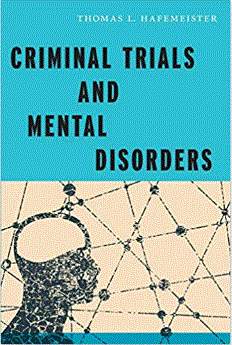
Criminal Trials and Mental Disorders

Thomas L. Hafemeister, Criminal Trials and Mental Disorders (New York University Press 2019).


The complicated relationship between defendants with mental health disorders and the criminal justice system 

The American criminal justice system is based on the bedrock principles of fairness and justice for all. In striving to ensure that all criminal defendants are treated equally under the law, it endeavors to handle similar cases in similar fashion, attempting to apply rules and procedures even-handedly regardless of a defendant’s social class, race, ethnicity, or gender. Yet, the criminal justice system has also recognized exceptions when special circumstances underlie a defendant’s behavior or are likely to skew the defendant’s trial. One of the most controversial set of exceptions –often poorly articulated and inconsistently applied – involves criminal defendants with a mental disorder.  

A series of special rules and procedures has evolved over the centuries, often without fanfare and even today with little systematic examination, that lawyers and judges apply to cases involving defendants with a mental disorder. This book provides an analysis of the key issues in this dynamic interplay between individuals with a mental disorder and the criminal justice system. 

The volume identifies the various stages of criminal justice proceedings when the mental status of a defendant may be relevant, associated legal and policy issues, the history and evolution of these issues, and how they are currently resolved. To assist this exploration, the text also offers an overview of mental disorders, their relevance to criminal proceedings, how forensic mental health assessments are conducted and employed during these proceedings, and their application to competency and responsibility determinations. In sum, this book provides an important resource for students and scholars with an interest in mental health, law, and criminal justice.
- Publisher's description         

Thursday, December 4, 2014

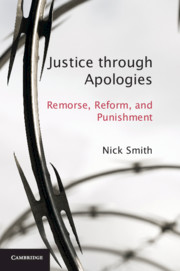
Justice through Apologies: Remorse, Reform, and Punishment

Nick Smith (University of New Hampshire). Justice through Apologies (Cambridge University Press, 2014).

"After rejecting court-ordered apologies as unjustifiable humiliation, this book explains that penitentiaries were originally designed to bring about penance – something like apology – and that this tradition has been lost in the assembly line of mass incarceration. Smith argues that the state should modernize these principles and techniques to reduce punishments for offenders who demonstrate moral transformation through apologizing. Smith also explains the counterintuitive situation whereby apologies come to have considerable financial worth in civil cases because victims associate them with priceless matters of the soul. Such confusions allow powerful wrongdoers to manipulate perceptions to disastrous effect, such as when corporations or governments assert that apologies do not equate to accepting blame or require reform or redress."
Publisher's website