Showing posts with label Tort law. Show all posts

Friday, March 18, 2022

Feminist Judgments: Rewritten Tort Opinions

Martha Chamallas & Lucinda M. Finley, Feminist Judgments: Rewritten Tort Opinions (Cambridge University Press, 2020).
By rewriting both canonical and lesser-known tort cases from a feminist perspective, this volume exposes gender and racial bias in how courts have categorized and evaluated harm stemming from prenatal malpractice, pregnancy loss, domestic violence, sexual assault and harassment, invasion of privacy, and the award of economic and noneconomic damages. The rewritten opinions demonstrate that when confronted with gendered harm to women, courts have often distorted or misapplied conventional legal doctrine to diminish the harm or deny recovery. Bringing this implicit bias to the surface can make law students, lawyers and judges who craft arguments and apply tort doctrines, more aware of inequalities of race, gender, class, and sexual orientation or gender identity. This volume shows the way forward to make the basic doctrines of tort law more responsive to the needs and perspectives of traditionally marginalized people, in ways that give greater value to harms that they disproportionately experience. 

-Publisher's Description

Monday, September 26, 2016

Private Wrongs

Arthur Ripstein (University of Toronto), Private Wrongs (Harvard Univ. Press 2016).

"A waiter spills hot coffee on a customer. A person walks on another person’s land. A moored boat damages a dock during a storm. A frustrated neighbor bangs on the wall. A reputation is ruined by a mistaken news report. Although the details vary, the law recognizes all of these as torts, different ways in which one person wrongs another. Tort law can seem puzzling: sometimes people are made to pay damages when they are barely or not at fault, while at other times serious losses go uncompensated. In this pioneering book, Arthur Ripstein brings coherence and unity to the baffling diversity of tort law in an original theory that is philosophically grounded and analytically powerful.

Ripstein shows that all torts violate the basic moral idea that each individual is in charge of his or her own person and property, and never in charge of another individual’s person or property. Battery and trespass involve one person wrongly using another’s body or things, while negligence injures others by imposing risks to them in ways that are inconsistent with their independence. Tort remedies aim to provide a substitute for the right that was violated.

As Private Wrongs makes clear, tort law not only protects our bodies and property but constitutes our entitlement to use them as we see fit, consistent with the entitlement of others to do the same."

Publisher's description

Monday, August 31, 2015

Teddy Roosevelt and the Marquette Libel Trial


Mikel B. Classen, Teddy Roosevelt and the Marquette Libel Trial (History Press, 2015).

"On the same day Theodore Roosevelt narrowly survived an assassination attempt, his press secretary handed him a newspaper editorial from the Iron Ore, a small-town daily located in Michigan's Upper Peninsula. Its publisher, George Newett, had printed, Roosevelt lies and curses in a most disgusting way; he gets drunk, too, and that not infrequently, and all his intimates know about it. Tired of having his boisterous personality equated with intoxication, Roosevelt angrily shouted, Let's go at him! and the paper was formally charged with a suit of libel. As the case convened, a cadre of admirals, statesmen and fellow explorers descended on Marquette to testify to T.R.'s unimpeachable personal character in the biggest libel trial of the early twentieth century." 
Publisher's description

Thursday, December 4, 2014

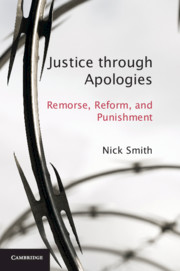
Justice through Apologies: Remorse, Reform, and Punishment

Nick Smith (University of New Hampshire). Justice through Apologies (Cambridge University Press, 2014).

"After rejecting court-ordered apologies as unjustifiable humiliation, this book explains that penitentiaries were originally designed to bring about penance – something like apology – and that this tradition has been lost in the assembly line of mass incarceration. Smith argues that the state should modernize these principles and techniques to reduce punishments for offenders who demonstrate moral transformation through apologizing. Smith also explains the counterintuitive situation whereby apologies come to have considerable financial worth in civil cases because victims associate them with priceless matters of the soul. Such confusions allow powerful wrongdoers to manipulate perceptions to disastrous effect, such as when corporations or governments assert that apologies do not equate to accepting blame or require reform or redress."
Publisher's website


Friday, October 3, 2014

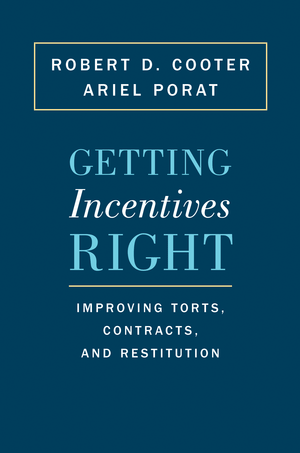
Getting Incentives Right: Improving Torts, Contracts, and Restitution

Robert D. Cooter (U.C. Berkeley) & Ariel Porat (Tel Aviv University). Getting Incentives Right (Princeton University Press, 2014).

"Lawyers, judges, and scholars have long debated whether incentives in tort, contract, and restitution law effectively promote the welfare of society. If these incentives were ideal, tort law would reduce the cost and frequency of accidents, contract law would lubricate transactions, and restitution law would encourage people to benefit others. Unfortunately, the incentives in these laws lead to too many injuries, too little contractual cooperation, and too few unrequested benefits. Getting Incentives Right explains how law might better serve the social good."

Publisher's Website

Wednesday, February 12, 2014

Tort Law: Challenging Orthodoxy

Stephen G.A. Pitel, Jason W. Neyers & Erika Chamberlain, eds. (Western University). Tort Law: Challenging Orthodoxy (Hart Publishing, 2013).

"In this book leading scholars from the United Kingdom, the United States and Australia challenge established common law rules and suggest new approaches to both old and emerging problems in tort law.  Some chapters consider broad issues such as the importance of flexibility over certainty in tort law, connections between tort law and human flourishing and the indirect effects of changes in tort law.  Other chapters engage more specific topics . . .  [they] propose new approaches to contributory negligence, emotional distress, loss of a chance, damages for nuisance, the tort of conspiracy and vicarious liability."
Tort Law: Challenging Orthodoxy book jacket