Friday, August 16, 2019

Courting the Community: Legitimacy and Punishment in a Community Court

Christine Zozula, Courting the Community: Legitimacy and Punishment in a Community Court (Temple Univ. Press, 2019).

Community Courts are designed to handle a city’s low-level offenses and quality-of-life crimes, such as littering, loitering, or public drunkenness. Court advocates maintain that these largely victimless crimes jeopardize the well-being of residents, businesses, and visitors. Whereas traditional courts might dismiss such cases or administer a small fine, community courts aim to meaningfully punish offenders to avoid disorder escalating to apocalyptic decline.

Courting the Community is a fascinating ethnography that goes behind the scenes to explore how quality-of-life discourses are translated into court practices that marry therapeutic and rehabilitative ideas. Christine Zozula shows how residents and businesses participate in meting out justice—such as through community service, treatment, or other sanctions—making it more emotional, less detached, and more legitimate in the eyes of stakeholders. She also examines both “impact panels,” in which offenders, residents, and business owners meet to discuss how quality-of-life crimes negatively impact the neighborhood, as well as strategic neighborhood outreach efforts to update residents on cases and gauge their concerns.

Zozula’s nuanced investigation of community courts can lead us to a deeper understanding of punishment and rehabilitation and, by extension, the current state of the American court system.

-Publisher's description

Friday, August 9, 2019

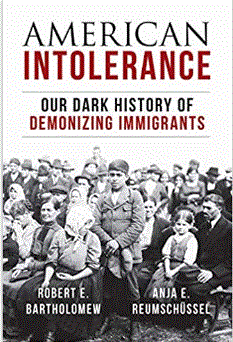
American Intolerance: Our Dark History of Demonizing Immigrants

Robert Bartholomew & Anja Reumschuessel, American Intolerance: Our Dark History of Demonizing Immigrants (Prometheus 2018).


This historical review of the US treatment of immigrants and minority groups documents the suspicion and persecution that often met newcomers and those perceived to be different.

Contrary to popular belief, the poor and huddled masses were never welcome in America. Though the engraving on the base of the Statue of Liberty makes that claim, history reveals a far less-welcoming message. This comprehensive survey of cultural and racial exclusion in the United States examines the legacy of hostility toward immigrants over two centuries.

The authors document abuses against Catholics in the early 19th century in response to the influx of German and Irish immigrants; hostility against Mexicans throughout the Southwest, where signs in bars and restaurants read, "No Dogs, No Negros, No Mexicans"; "yellow peril" fears leading to a ban on Chinese immigration for ten years; punitive measures against Native Americans traditions, which became punishable by fines and hard labor; the persecution of German Americans during World War I and Japanese Americans during World War II; the refusal to admit Jewish refugees of the Holocaust; and the ongoing legacy of mistreating African Americans from slavery to the injustices of the present day.

Though the authors note that the United States has accepted tens of millions of immigrants during its relatively short existence, its troubling history of persecution is often overlooked. President Donald Trump's targeting of Muslim and Mexican immigrants is just the most recent chapter in a long, sad history of social panics about "evil" foreigners who are made scapegoats due to their ethnicity or religious beliefs.
- Publisher's description                                       

Friday, August 2, 2019

Does America Need More Innovators?

Matthew Wisnioski (Virginia Tech) ed., Does America Need More Innovators? (MIT Press 2019).


A critical exploration of today's global imperative to innovate, by champions, critics, and reformers of innovation.
Corporate executives, politicians, and school board leaders agree―Americans must innovate. Innovation experts fuel this demand with books and services that instruct aspiring innovators in best practices, personal habits, and workplace cultures for fostering innovation. But critics have begun to question the unceasing promotion of innovation, pointing out its gadget-centric shallowness, the lack of diversity among innovators, and the unequal distribution of innovation's burdens and rewards. Meanwhile, reformers work to make the training of innovators more inclusive and the outcomes of innovation more responsible. This book offers an overdue critical exploration of today's global imperative to innovate by bringing together innovation's champions, critics, and reformers in conversation.
The book presents an overview of innovator training, exploring the history, motivations, and philosophies of programs in private industry, universities, and government; offers a primer on critical innovation studies, with essays that historicize, contextualize, and problematize the drive to create innovators; and considers initiatives that seek to reform and reshape what it means to be an innovator.

- Publisher's description                          

Tuesday, July 30, 2019

Almost Citizens: Puerto Rico, the U.S. Constitution, and Empire

Sam Erman, Almost Citizens: Puerto Rico, the U.S. Constitution, and Empire (Cambridge Univ. Press, 2019).

Almost Citizens lays out the tragic story of how the United States denied Puerto Ricans full citizenship following annexation of the island in 1898. As America became an overseas empire, a handful of remarkable Puerto Ricans debated with US legislators, presidents, judges, and others over who was a citizen and what citizenship meant. This struggle caused a fundamental shift in constitution law: away from the post-Civil War regime of citizenship, rights, and statehood and toward doctrines that accommodated racist imperial governance. Erman's gripping account shows how, in the wake of the Spanish-American War, administrators, lawmakers, and presidents together with judges deployed creativity and ambiguity to transform constitutional meaning for a quarter of a century. The result is a history in which the United States and Latin America, Reconstruction and empire, and law and bureaucracy intertwine.

-Publisher's description

Monday, July 29, 2019

Deported Americans

Beth C. Caldwell, Deported Americans (Duke Univ. Press, 2019).

When Gina was deported to Tijuana, Mexico, in 2011, she left behind her parents, siblings, and children, all of whom are U.S. citizens. Despite having once had a green card, Gina was removed from the only country she had ever known. In Deported Americans legal scholar and former public defender Beth C. Caldwell tells Gina's story alongside those of dozens of other Dreamers, who are among the hundreds of thousands who have been deported to Mexico in recent years. Many of them had lawful status, held green cards, or served in the U.S. military. Now, they have been banished, many with no hope of lawfully returning. Having interviewed over one hundred deportees and their families, Caldwell traces deportation's long-term consequences—such as depression, drug use, and homelessness—on both sides of the border. Showing how U.S. deportation law systematically fails to protect the rights of immigrants and their families, Caldwell challenges traditional notions of what it means to be an American and recommends legislative and judicial reforms to mitigate the injustices suffered by the millions of U.S. citizens affected by deportation.

-publisher's description