Showing posts with label Duke University. Show all posts

Wednesday, September 28, 2016

Finding Consciousness

Walter Sinnott-Armstrong (ed.) (Duke University),  Finding Consciousness (Oxford Univ. Press 2016).

"Modern medicine enables us to keep many people alive after they have suffered severe brain damage and show no reliable outward signs of consciousness. Many such patients are misdiagnosed as being in a permanent vegetative state when they are actually in a minimally conscious state. This mistake has far-reaching implications for treatment and prognosis. To alleviate this problem, neuroscientists have recently developed new brain-scanning methods to detect consciousness in some of these patients and even to ask them questions, including "Do you want to stay alive?"

Finding Consciousness: The Neuroscience, Ethics, and Law of Severe Brain Damage addresses many questions regarding these recent neuroscientific methods: Is what these methods detect really consciousness? Do patients feel pain? Should we decide whether or not to let them die or are they competent to decide for themselves? And which kinds of treatment should governments and hospitals make available? This edited volume provides contextual information, surveys the issues and positions, and takes controversial stands from a wide variety of prominent contributors in fields ranging from neuroscience and neurology to law and policy to philosophy and ethics. Finding Consciousness should interest not only neuroscientists, clinicians, and ethicists but anyone who might suffer brain damage, which includes us all."
Publisher's description

Wednesday, May 6, 2015

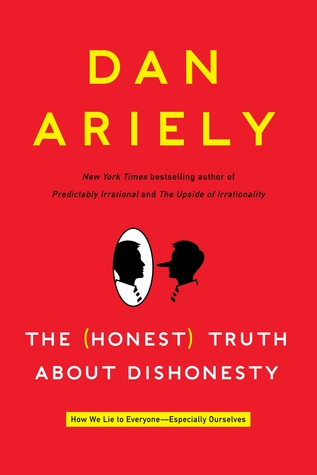
The (Honest) Truth about Dishonesty: How We Lie to Everyone—Especially Ourselves

Dan Ariely (Duke University). The (Honest) Truth about Dishonesty (Harper, 2012).

"Mr. Ariely, a professor of psychology and behavioral economics at Duke University, sets out to ask why and when cheating occurs, whether it is useful and how it can be discouraged. He also defines the paradoxical nature of dishonesty. In a conversational style drawn straight from the classroom he promises that 'we will discuss what makes dishonesty rear its ugly head and how we cheat for our own benefit while maintaining a positive view of ourselves — a facet of our behavior that enables much of our dishonesty.') He will do this by staging many small, simple experiments that grapple with the obvious in science-made-easy fashion. . . . For instance: If a refrigerator in a college dormitory contains cans of Coca-Cola and dollar bills, which will disappear faster? Hints: College students don’t often want to perceive themselves as thieves. And they are often thirsty."

—Janet Maslin, New York Times