Showing posts with label Psychology. Show all posts

Friday, August 23, 2019

Biased: Uncovering the Hidden Prejudice That Shapes What We See, Think, and Do

Jennifer L. Eberhardt, Biased: Uncovering the Hidden Prejudice That Shapes What We See, Think, and Do (Penguin Random House, 2019).

You don’t have to be racist to be biased. Unconscious bias can be at work without our realizing it, and even when we genuinely wish to treat all people equally, ingrained stereotypes can infect our visual perception, attention, memory, and behavior. This has an impact on education, employment, housing, and criminal justice. In Biased, with a perspective that is at once scientific, investigative, and informed by personal experience, Jennifer Eberhardt offers us insights into the dilemma and a path forward.

Eberhardt works extensively as a consultant to law enforcement and as a psychologist at the forefront of this new field. Her research takes place in courtrooms and boardrooms, in prisons, on the street, and in classrooms and coffee shops. She shows us the subtle–and sometimes dramatic–daily repercussions of implicit bias in how teachers grade students, or managers deal with customers. It has an enormous impact on the conduct of criminal justice, from the rapid decisions police officers have to make to sentencing practices in court. Eberhardt’s work and her book are both influenced by her own life, and the personal stories she shares emphasize the need for change. She has helped companies that include Airbnb and Nextdoor address bias in their business practices and has led anti-bias initiatives for police departments across the country. Here, she offers practical suggestions for reform and new practices that are useful for organizations as well as individuals.

Unblinking about the tragic consequences of prejudice, Eberhardt addresses how racial bias is not the fault of nor restricted to a few “bad apples” but is present at all levels of society in media, education, and business. The good news is that we are not hopelessly doomed by our innate prejudices. In Biased, Eberhardt reminds us that racial bias is a human problem–one all people can play a role in solving.

-Publisher's description

Thursday, January 12, 2017

Anatomy of Malice: The Enigma of the Nazi War Criminals

Joel E. Dimsdale (U.C. San Diego), Anatomy of Malice: The Enigma of the Nazi War Criminals (Yale Univ. Press 2016).

"...Before the war crimes trial began, it was self-evident to most people that the Nazi leaders were demonic maniacs. But when the interviews and psychological tests were completed, the answer was no longer so clear. The findings were so disconcerting that portions of the data were hidden away for decades and the research became a topic for vituperative disputes. Gilbert thought that the war criminals’ malice stemmed from depraved psychopathology. Kelley viewed them as morally flawed, ordinary men who were creatures of their environment. Who was right?

Drawing on his decades of experience as a psychiatrist and the dramatic advances within psychiatry, psychology, and neuroscience since Nuremberg, Joel E. Dimsdale looks anew at the findings and examines in detail four of the war criminals, Robert Ley, Hermann Göring, Julius Streicher, and Rudolf Hess. Using increasingly precise diagnostic tools, he discovers a remarkably broad spectrum of pathology. Anatomy of Malice takes us on a complex and troubling quest to make sense of the most extreme evil."

Publisher's description

Wednesday, May 6, 2015

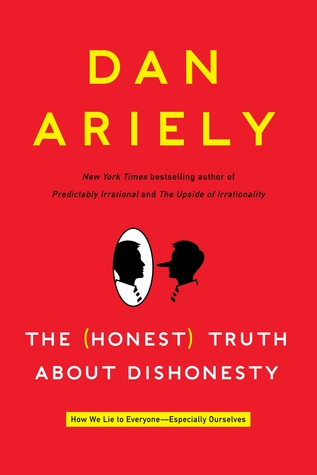
The (Honest) Truth about Dishonesty: How We Lie to Everyone—Especially Ourselves

Dan Ariely (Duke University). The (Honest) Truth about Dishonesty (Harper, 2012).

"Mr. Ariely, a professor of psychology and behavioral economics at Duke University, sets out to ask why and when cheating occurs, whether it is useful and how it can be discouraged. He also defines the paradoxical nature of dishonesty. In a conversational style drawn straight from the classroom he promises that 'we will discuss what makes dishonesty rear its ugly head and how we cheat for our own benefit while maintaining a positive view of ourselves — a facet of our behavior that enables much of our dishonesty.') He will do this by staging many small, simple experiments that grapple with the obvious in science-made-easy fashion. . . . For instance: If a refrigerator in a college dormitory contains cans of Coca-Cola and dollar bills, which will disappear faster? Hints: College students don’t often want to perceive themselves as thieves. And they are often thirsty."

—Janet Maslin, New York Times

Friday, February 27, 2015

The Best Interests of the Child: The Least Detrimental Alternative

Joseph Goldstein, Albert J. Solnit, Sonja Goldstein & Anna Freud (Yale University). The Best Interests of the Child (Free Press, 1996 edition).

"The authors speak in one voice in concluding that the continuity of care--continuity of a child's relationship with his or her adult caregiver--is a universal essential to the child's well-being. To this end, they stress that minimizing intrusions by the law is paramount to safeguarding the child's growth and development. 'The least detrimental alternative'--the authors' overarching guideline for assuring the continuity of the psychological parent-child relationship--has been cited in more than a thousand child custody cases since 1973."
Book jacket