Joel E. Dimsdale (U.C. San Diego), Anatomy of Malice: The Enigma of the Nazi War Criminals (Yale Univ. Press 2016).
"...Before the war crimes trial began, it was self-evident to most people that the Nazi leaders were demonic maniacs. But when the interviews and psychological tests were completed, the answer was no longer so clear. The findings were so disconcerting that portions of the data were hidden away for decades and the research became a topic for vituperative disputes. Gilbert thought that the war criminals’ malice stemmed from depraved psychopathology. Kelley viewed them as morally flawed, ordinary men who were creatures of their environment. Who was right?
Drawing on his decades of experience as a psychiatrist and the dramatic advances within psychiatry, psychology, and neuroscience since Nuremberg, Joel E. Dimsdale looks anew at the findings and examines in detail four of the war criminals, Robert Ley, Hermann Göring, Julius Streicher, and Rudolf Hess. Using increasingly precise diagnostic tools, he discovers a remarkably broad spectrum of pathology. Anatomy of Malice takes us on a complex and troubling quest to make sense of the most extreme evil."
—Publisher's description
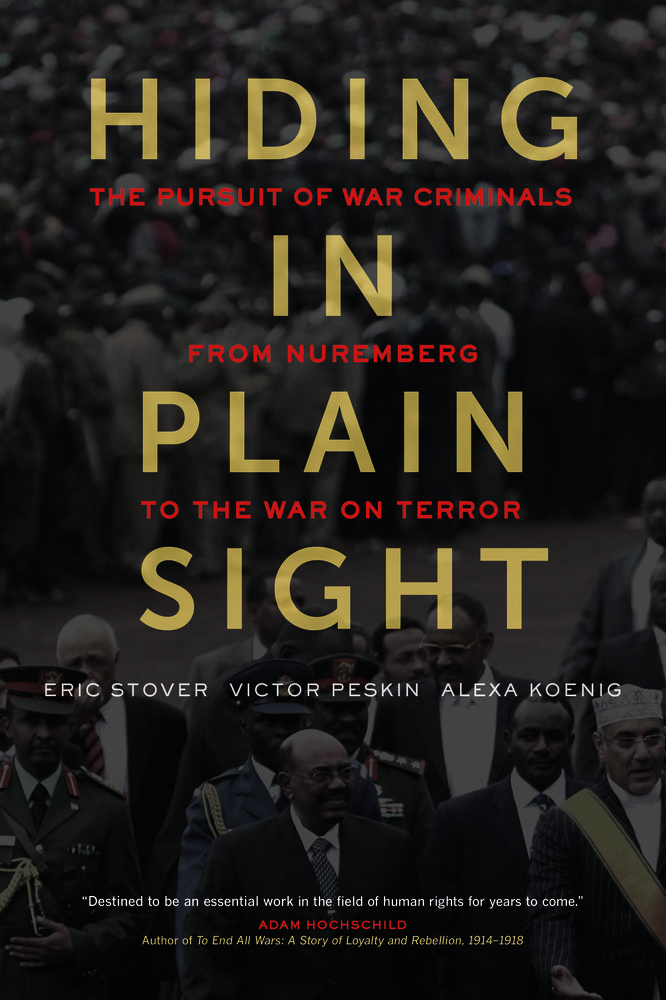
Eric Stover (U.C. Berkeley), Victor Peskin (Arizona State University), & Alexa Koenig (U.C. Berkeley), Hiding in Plain Sight: The Pursuit of War Criminals from Nuremberg to the War on Terror (Univ. of California Press 2016).

Hiding in Plain Sight tells the story of the global effort to apprehend the world’s most wanted fugitives. Beginning with the flight of tens of thousands of Nazi war criminals and their collaborators after World War II, then moving on to the question of justice following the recent Balkan wars and the Rwandan genocide, and ending with the establishment of the International Criminal Court and America’s pursuit of suspected terrorists in the aftermath of 9/11, the book explores the range of diplomatic and military strategies—both successful and unsuccessful—that states and international courts have adopted to pursue and capture war crimes suspects. It is a story fraught with broken promises, backroom politics, ethical dilemmas, and daring escapades—all in the name of international justice and human rights.
—Publisher's description
 Chiseche Salome Mibenge (City University of New York). Sex and International Tribunals (University of Pennsylvania Press, 2013).
"Before the twenty-first century, there was little legal precedent for the prosecution of sexual violence as a war crime. Now, international tribunals have the potential to help make sense of political violence against both men and women; they have the power to uphold victims' claims and to convict the leaders and choreographers of systematic atrocity. However, by privileging certain accounts of violence over others, tribunals more often confirm outmoded gender norms, consigning women to permanent rape victim status."
—Sex and International Tribunals book jacket
 Valerie Geneviève Hébert (University of Toronto). Hitler’s Generals on Trial: The Last War Crimes Tribunal At Nuremburg (University Press of Kansas, 2010).
“A thoughtful and sobering work. Hébert delivers a complicated story with clarity and balance: a story of noble ideals that fell short in practice, of national self-delusion and political compromise, of revealed truths that took generations to sink in, and of legal innovations that still affect us today.”
—Geoffrey P. Megargee, author of Inside Hitler’s High Command