Showing posts with label International courts. Show all posts

Monday, November 18, 2019

The Case for an International Court of Civil Justice

Maya Steinitz, The Case for an International Court of Civil Justice (Cambridge University Press, 2019).
When multinational corporations cause mass harms to lives, livelihoods, and the environment in developing countries, it is nearly impossible for victims to find a court that can and will issue an enforceable judgment. In this work, Professor Maya Steinitz presents a detailed rationale for the creation of an International Court of Civil Justice (ICCJ) to hear such transnational mass tort cases. The world's legal systems were not designed to solve these kinds of complex transnational disputes, and the absence of mechanisms to ensure coordination means that victims try, but fail, to find justice in country after country, court after court. The Case for an International Court of Civil Justice explains how the ICCJ would provide victims with access to justice and corporate defendants with a non-corrupt forum and an end to the cost and uncertainty of unending litigation -- more efficiently resolving the most complicated types of civil litigation.
-Publisher's Description

Thursday, November 10, 2016

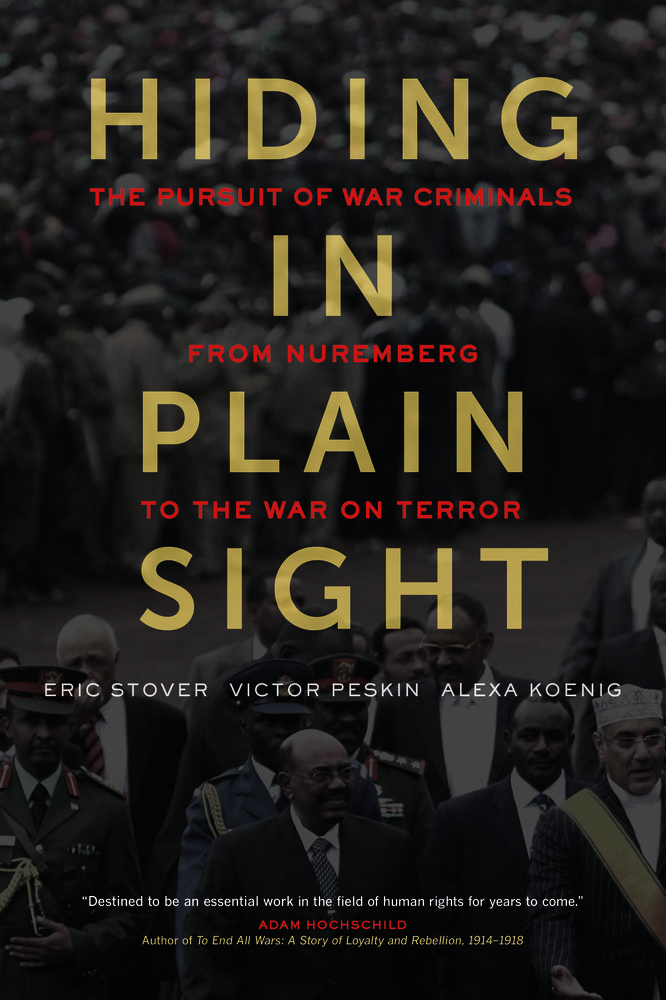
Hiding in Plain Sight

Eric Stover (U.C. Berkeley), Victor Peskin (Arizona State University), & Alexa Koenig (U.C. Berkeley), Hiding in Plain Sight: The Pursuit of War Criminals from Nuremberg to the War on Terror (Univ. of California Press 2016).

Hiding in Plain Sight tells the story of the global effort to apprehend the world’s most wanted fugitives. Beginning with the flight of tens of thousands of Nazi war criminals and their collaborators after World War II, then moving on to the question of justice following the recent Balkan wars and the Rwandan genocide, and ending with the establishment of the International Criminal Court and America’s pursuit of suspected terrorists in the aftermath of 9/11, the book explores the range of diplomatic and military strategies—both successful and unsuccessful—that states and international courts have adopted to pursue and capture war crimes suspects. It is a story fraught with broken promises, backroom politics, ethical dilemmas, and daring escapades—all in the name of international justice and human rights. 

Publisher's description

Monday, March 2, 2015

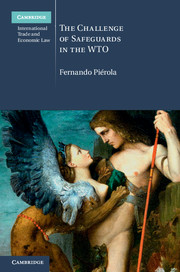
The Challenge of Safeguards in the WTO

Fernando Pierola (University of Berne). The Challenge of Safeguards in the WTO (Cambridge University Press, 2014).

"The Challenge of Safeguards in the WTO provides a comprehensive overview of the safeguard mechanism in the multilateral trading system. It explains at length its historical and conceptual foundations and elaborates on the various requirements for the imposition of safeguards and the conduct of safeguard investigations. The author draws on his practical experience in order to analyse WTO case law as developed by WTO panels and the Appellate Body and to provide practical suggestions for the resolution of various complex issues which have arisen in practice. He also considers the challenges faced by companies involved in this type of case."

Publisher's website


Monday, November 10, 2014

Seeking Human Rights Justice in Latin America: Truth, Extra-Territorial Courts, and the Process of Justice

Jeffrey Davis (University of Maryland), Seeking Human Rights Justice in Latin America (Cambridge University Press, 2013).

"This book studies how victims of human rights violations in Latin America, their families, and their advocates work to overcome entrenched impunity and seek legal justice. Their struggles show that legal justice is a multifaceted process, the overarching purpose of which is to restore human dignity and prevent further violence. Uncovering, revealing, and proving the truth are essential elements of legal justice, and are also powerful tools to activate the process. When faced with stubborn impunity at home, victims, families, and advocates can carry on their work for legal justice by bringing cases in courts in other countries or in the Inter-American human rights system. These extra-territorial courts can jumpstart the process of legal justice at home."

Publisher's website