Lee Epstein (Washington University) & Andrew D. Martin (University of Michigan). An Introduction to Empirical Research (Oxford University Press, 2014).
"As the role of empirical methods in traditional legal scholarship and practice grows, new forms of education are needed for today's lawyers. All lawyers asked to present or assess empirical arguments need to understand the fundamental principles of social science methodology that underpin sound empirical research. An Introduction to Empirical Research presents that methodology in a legal context, explaining how empirical analysis can inform legal arguments; how lawyers can set about framing empirical questions, conducting empirical research, analyzing data, and presenting or evaluating the results. The fundamentals of understanding data, statistical models, and the structure of empirical arguments are explained in a way accessible to lawyers with or without formal training in statistics."
—From book jacket
Showing posts with label Empirical studies. Show all posts
Thursday, December 11, 2014
Tuesday, May 6, 2014
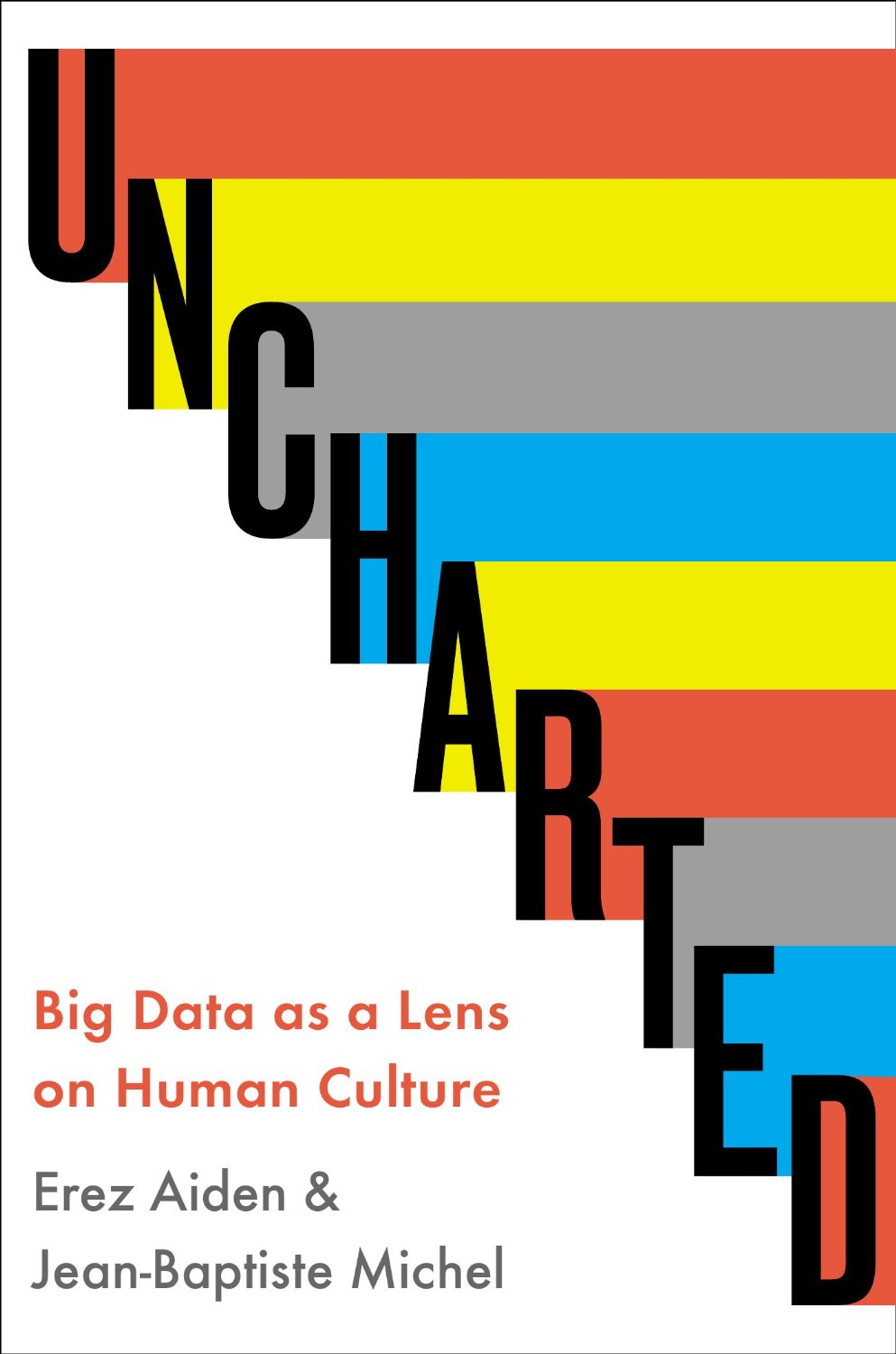
Uncharted: Big Data as a Lens on Human Culture
Erez Aiden & Jean-Baptiste Michel (Baylor College of Medicine, Harvard University). Uncharted (Riverhead Books, 2013).
"[Uncharted] tells the story of how Aiden and Michel built . . . an addictive online tool called the Google Ngram Viewer.
Based on the belief that 'the books of a particular time and place are among the most important sources of information about that time and that place,' the Ngram Viewer instantly reads the texts of about 6 percent of all books ever published (yes, you read that correctly) to produce line graphs charting the frequency of certain words over a certain period of time.
'Very cool,' you say. 'But so what?' Erez and Michel, who call their work 'culturomics' are still, to a degree, working that out. 'This is the frontier of science,' they write. 'There is no map, lots of guesswork, and plenty of blind alleys, but there's no place better.' What is clear, however, is the Ngram Viewer's staggering potential to reveal hidden parts of our world."
—John Wilwol, San Francisco Chronicle
Wednesday, January 29, 2014
A Mere Machine: The Supreme Court, Congress, and American Democracy
Anna Harvey (New York University). A Mere Machine (Yale University Press, 2013).
"In this groundbreaking new work, Anna Harvey reports evidence showing that the Supreme Court is in fact extraordinarily deferential to congressional preferences in its constitutional findings. Analyzing cross-national evidence, Harvey also finds that the rights protections we enjoy in the United States appear to be largely due to the fact that we do not have an independent Supreme Court."
—A Mere Machine Book Jacket
"In this groundbreaking new work, Anna Harvey reports evidence showing that the Supreme Court is in fact extraordinarily deferential to congressional preferences in its constitutional findings. Analyzing cross-national evidence, Harvey also finds that the rights protections we enjoy in the United States appear to be largely due to the fact that we do not have an independent Supreme Court."
—A Mere Machine Book Jacket
Subscribe to:
Posts (Atom)