Showing posts with label Statistics. Show all posts

Friday, January 28, 2022

The Supreme Court


Tom S. Clark, The Supreme Court: An Analytic History of Constitutional Decision Making (Cambridge University Press, 2019). 

This book presents a quantitative history of constitutional law in the United States and brings together humanistic and social-scientific approaches to studying law. Using theoretical models of adjudication, Tom S. Clark presents a statistical model of law and uses the model to document the historical development of constitutional law. Using sophisticated statistical methods and historical analysis of Court decisions, the author documents how social and political forces shape the path of law. Spanning the history of constitutional law since Reconstruction, this book illustrates the way in which the law evolves with American life and argues that a social-scientific approach to the history of law illuminates connections across disparate areas of law, connected by the social context in which the Constitution has been interpreted. 

-Publisher's Description

Thursday, May 29, 2014

The Leading Indicators: A Short History of the Numbers that Rule our World

Zachary Karabell. The Leading Indicators (Simon & Schuster, 2014).
"Zachary Karabell’s lively account, 'The Leading Indicators,' is a terrific introduction to the range of statistics economists and governments use to address these questions. As Karabell tells us, the role of the government in the economy explains why we have the statistics we do: 'Until the early 20th century, significant economic hardship was so woven into human history and experience that it wasn’t yet seen as an aberration. Only the combination of a severe crisis and the belief that such crises not only could but should be prevented by collective government action led to the creation of unemployment statistics.' Karabell also shows how many judgment calls are involved in developing statistics. Even so seemingly straightforward a measure as unemployment requires assumptions — for example about how to treat transient workers or students or people who are working fewer hours than they would like."
—Diane Coyle, New York Times 

Tuesday, May 6, 2014

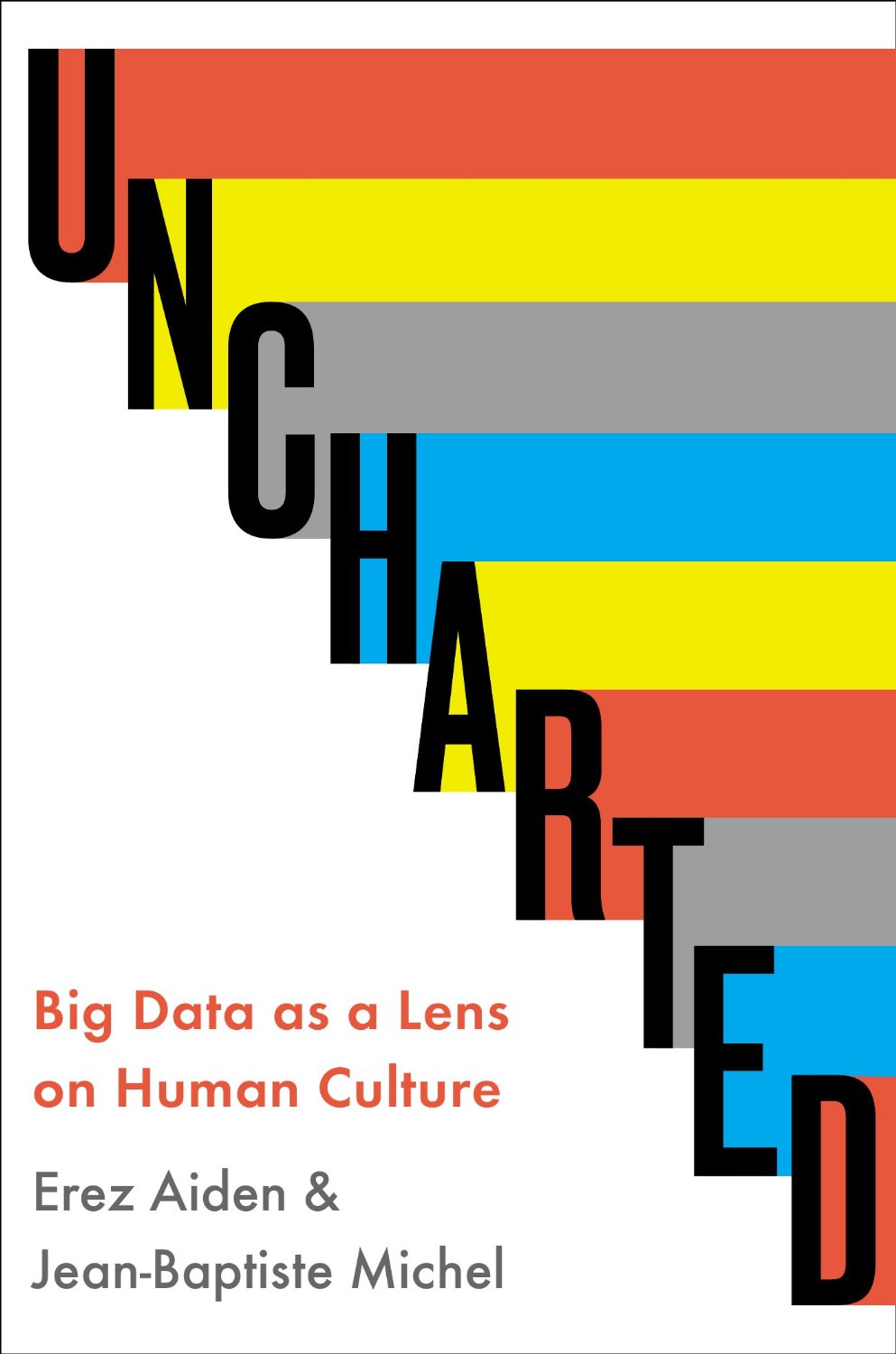
Uncharted: Big Data as a Lens on Human Culture

Erez Aiden & Jean-Baptiste Michel (Baylor College of Medicine, Harvard University). Uncharted (Riverhead Books, 2013).

"[Uncharted] tells the story of how Aiden and Michel built . . . an addictive online tool called the Google Ngram Viewer.

Based on the belief that 'the books of a particular time and place are among the most important sources of information about that time and that place,' the Ngram Viewer instantly reads the texts of about 6 percent of all books ever published (yes, you read that correctly) to produce line graphs charting the frequency of certain words over a certain period of time.

'Very cool,' you say. 'But so what?' Erez and Michel, who call their work 'culturomics' are still, to a degree, working that out. 'This is the frontier of science,' they write. 'There is no map, lots of guesswork, and plenty of blind alleys, but there's no place better.' What is clear, however, is the Ngram Viewer's staggering potential to reveal hidden parts of our world."
—John Wilwol, San Francisco Chronicle