Showing posts with label Employment Law. Show all posts

Tuesday, June 15, 2021

Humans as a Service

Jeremias Prassl, Humans as a Service: The Promise and Perils of Work in the Gig Economy (Oxford University Press, 2018).

As courts and governments around the world begin to grapple with the gig economy, Humans as a Service explores the challenges of on-demand work, and explains how we can ensure decent working conditions, protect consumers, and foster innovation. Employment law plays a central role in levelling the playing field: gigs, tasks, and rides are work -- and should be regulated as such. 

-Publisher's Description

Wednesday, April 15, 2015

The Eternal Criminal Record

James B. Jacobs (New York University). The Eternal Criminal Record (Harvard University Press, 2015).


"The United States is unique in making criminal information easy to obtain by employers, landlords, neighbors, even cyberstalkers. Its nationally integrated rap-sheet system is second to none as an effective law enforcement tool, but it has also facilitated the transfer of ever more sensitive information into the public domain. While there are good reasons for a person’s criminal past to be public knowledge, records of arrests that fail to result in convictions are of questionable benefit. Simply by placing someone under arrest, a police officer has the power to tag a person with a legal history that effectively incriminates him or her for life."
From publisher's website

Tuesday, January 27, 2015

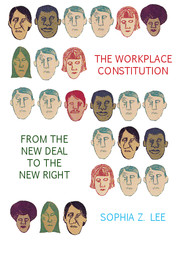
The Workplace Constitution from the New Deal to the New Right

Sophia Z. Lee (University of Pennsylvania). The Workplace Constitution from the New Deal to the New Right (Cambridge University Press, 2014).

"Today, most Americans lack constitutional rights on the job. Instead of enjoying free speech or privacy, they can be fired for almost any reason or no reason at all. This book uses history to explain why. It takes readers back to the 1930s and 1940s when advocates across the political spectrum – labor leaders, civil rights advocates, and conservatives opposed to government regulation – set out to enshrine constitutional rights in the workplace. The book tells their interlocking stories of fighting for constitutional protections for American workers, recovers their surprising successes, explains their ultimate failure, and helps readers assess this outcome."
Publisher's website

Tuesday, September 23, 2014

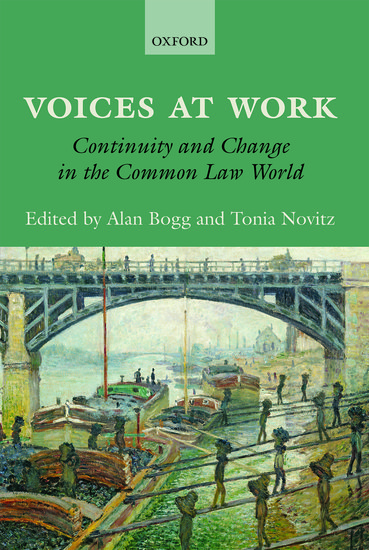
Voices at Work: Continuity and Change in the Common Law World

Alan Bogg (University of Oxford) & Tonia Novitz (University of Bristol). Voices at Work (Oxford University Press, 2014).

"The book aims to shed light on the problematic concept of worker 'voice' by tracking its evolution and its complex interactions with various forms of law. Contributors to the volume identify the scope for continuity of legal approaches to voice and the potential for change in a sample of industrialised English speaking common law countries . . . . These countries, facing broadly similar regulatory dilemmas, have often sought to borrow and adapt certain legal mechanisms from one another. The variance in the outcomes of any attempts at 'borrowing' seems to demonstrate that, despite apparent membership of a 'common law' family, there are significant differences between industrial systems and constitutional traditions, thereby casting doubt on the notion that there are definitive legal solutions which can be applied through transplantation."
Publisher's Website

Friday, June 27, 2014

The Crusade for Equality in the Workplace: The Griggs v. Duke Power Story

Robert Belton (Vanderbilt University). The Crusade for Equality in the Workplace (University Press of Kansas, 2014).

"Title VII of the Civil Rights Act of 1964 eliminated much blatant discrimination, but after its enactment before Griggs, businesses held the view that a commitment to equality required only eliminating policies and practices that were intentionally discriminatory—the 'disparate treatment' test. . . . In Griggs v. Duke Power Co., the Supreme Court ruled that a 'disparate impact' test could also apply—that the 1964 Civil Rights Act extended to practices with a discriminatory effect. In tracing the impact of the Griggs ruling on employment practices, this book documents the birth, maturation, death and rebirth of disparate impact theory, including its erosion by later Supreme Court decisions and its restoration by congressional action in the Civil Rights Act of 1991."
The Crusade for Equality in the Workplace book jacket