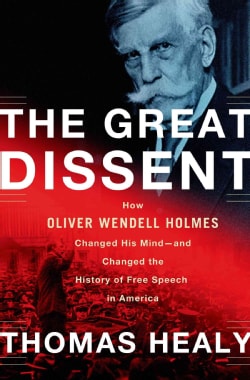
Thomas Healy (Seton Hall). The Great Dissent (Metropolitan Books, 2013).
"Now, with the aid of newly discovered letters and confidential memos, law professor Thomas Healy reconstructs in vivid detail Holmes's journey from free-speech opponent to First Amendment hero. It is the story of a remarkable behind-the-scenes campaign by a group of progressives to bring a legal icon to their way of thinking—and a deeply touching human narrative of an old man saved from his loneliness and despair by a few unlikely young friends."
—The Great Dissent book jacket
 Marc Doussard (University of Illinois). Degraded Work (University of Minnesota Press, 2013).
"Drawing on fieldwork in Chicago, Degraded Work examines changes
in two industries in which inferior job quality is assumed to be
intrinsic: residential construction and food retail. Arguing that a
growing service sector does not have to mean growing inequality, Marc
Doussard proposes creative policy and organizing opportunities to
improve job quality despite the overwhelming barriers to national
political action."
—From publisher's website
Marc Doussard (University of Illinois). Degraded Work (University of Minnesota Press, 2013).
"Drawing on fieldwork in Chicago, Degraded Work examines changes
in two industries in which inferior job quality is assumed to be
intrinsic: residential construction and food retail. Arguing that a
growing service sector does not have to mean growing inequality, Marc
Doussard proposes creative policy and organizing opportunities to
improve job quality despite the overwhelming barriers to national
political action."
—From publisher's website
Stephen G.A. Pitel, Jason W. Neyers & Erika Chamberlain, eds. (Western University). Tort Law: Challenging Orthodoxy (Hart Publishing, 2013).
"In this book leading scholars from the United Kingdom, the United States and Australia challenge established common law rules and suggest new approaches to both old and emerging problems in tort law. Some chapters consider broad issues such as the importance of flexibility over certainty in tort law, connections between tort law and human flourishing and the indirect effects of changes in tort law. Other chapters engage more specific topics . . . [they] propose new approaches to contributory negligence, emotional distress, loss of a chance, damages for nuisance, the tort of conspiracy and vicarious liability."
—Tort Law: Challenging Orthodoxy book jacket
Orly Lobel (University of San Diego). Talent Wants to be Free (Yale University Press, 2013).
"This
timely book challenges conventional business wisdom about competition,
secrecy, motivation, and creativity. Orly Lobel, an internationally
acclaimed expert in the law and economics of human capital, warns that a
set of counter-productive mentalities are stifling innovation in many
regions and companies. Lobel asks how innovators, entrepreneurs,
research teams, and every one of use who experiences the occasional
spark of creativity can triumph in today's innovation ecosystem."
—Talent Wants to be Free book jacket
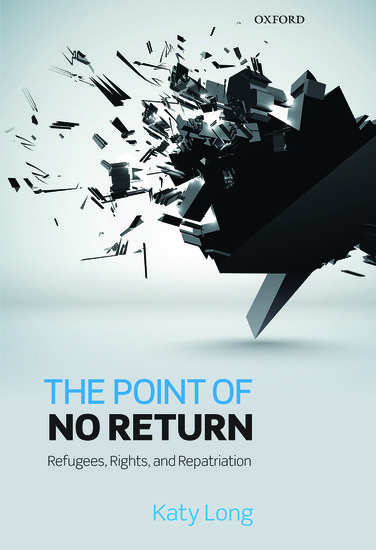
Katy Long (University of Edinburgh). The Point of No Return (Oxford University Press, 2013).
The Point of No Return: Refugees, Rights, and Repatriation sets out . . . to examine the fundamental tensions between liberalism and nationalism that repatriation exposes. It makes clear that repatriation cannot be considered as a mere act of border-crossing, a physical moment of 'return'. Instead, repatriation must be recognized to be a complex political process, involving the remaking of a relationship between citizen and state, the recreation of a social contract.
—The Point of No Return book jacket
 Thomas Healy (Seton Hall). The Great Dissent (Metropolitan Books, 2013).