Tuesday, April 1, 2014

Sex and International Tribunals: The Erasure of Gender from the War Narrative

Chiseche Salome Mibenge (City University of New York). Sex and International Tribunals (University of Pennsylvania Press, 2013).


"Before the twenty-first century, there was little legal precedent for the prosecution of sexual violence as a war crime. Now, international tribunals have the potential to help make sense of political violence against both men and women; they have the power to uphold victims' claims and to convict the leaders and choreographers of systematic atrocity. However, by privileging certain accounts of violence over others, tribunals more often confirm outmoded gender norms, consigning women to permanent rape victim status."
Sex and International Tribunals book jacket

Wednesday, March 26, 2014

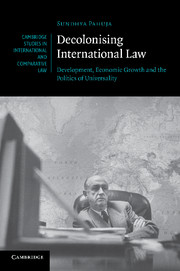
Decolonising International Law: Development, Economic Growth and the Politics of Universality

Sundhya Pahuja (Melbourne Law School). Decolonising International Law (Cambridge University Press, 2011).

"The universal promise of contemporary international law has long inspired countries of the Global South to use it as an important field of contestation over global inequality. Taking three central examples, Sundhya Pahuja argues that this promise has been subsumed within a universal claim for a particular way of life by the idea of 'development'. As the horizon of the promised transformation and concomitant equality has receded ever further, international law has legitimised an ever-increasing sphere of intervention in the Third World."
Decolonizing International Law book jacket

Monday, March 24, 2014

Justice among Nations: A History of International Law

Stephen C. Neff (University of Edinburgh). Justice among Nations (Harvard University Press, 2014).

"Stephen Neff avoids technical jargon as he surveys doctrines from natural law to feminism, and practices from the Warring States of China to the international criminal courts of today. Ancient China produced the first rudimentary set of doctrines. But the cornerstone of later international law was laid by the Romans, in the form of natural law—a universal law that was superior to early laws and governments. . . . New challenges in the nineteenth century encompassed the advance of nationalism, the rise of free trade and European imperialism, the formation of international organizations, and the arbitration of disputes. . . . The twentieth century witnessed the formation of the League of Nations and a World Court, but also the rise of socialist and fascist states and the advent of the Cold War. . . . . As Neff makes clear, further threats to the rule of law today come from environmental pressures, genocide, and terrorism."—Justice among Nations book jacket

Friday, March 21, 2014

Polygamy's Rights and Wrongs: Perspectives on Harm, Family and Law

Gillian Calder & Lori G. Beaman (eds.)(University of Victoria, University of Ottawa). Polygamy's Rights and Wrongs (UBC Press, 2014).

"Assumptions about the harmful nature of polygamy have left little room for debate, the monogamy coming to represent a hallmark of advanced societies, and polygamy the immoral alternative. Yet in this volume, eleven scholars ask whether this condemnation is justified by examining, among other perspectives, the lived experiences of polygamous families. In essays that fearlessly face difficult questions of choice, dignity, and love, the authors seek to complicate a conversation that is more often simplified."
Polygamy's Rights and Wrongs book jacket

Wednesday, March 19, 2014

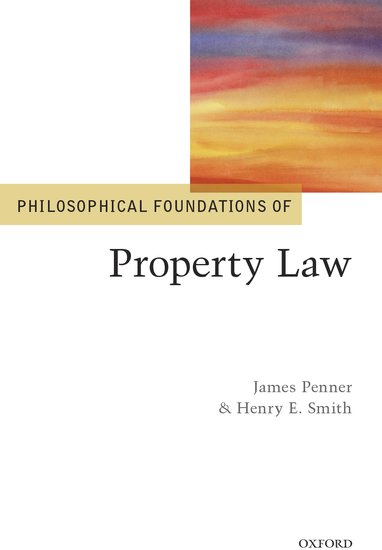
Philosophical Foundations of Property Law

James Penner & Henry E. Smith (eds.) (National University of Singapore, Harvard University). Philosophical Foundations of Property Law (Oxford University Press, 2013).

"Property has long played a central role in political and moral philosophy. Philosophers dealing with property have tended to follow the consensus that property has no special content but is a protean construct - a mere placeholder for theories aimed at questions of distributive justice and efficiency. Until recently there has been a relative absence of serious philosophical attention paid to the various doctrines that shape the actual law of property. If the philosophy of property is to be more attentive to concepts lying between broad considerations of political philosophy and distributive justice on the one hand and individual rules on the other, what in this broad space needs explaining, and how might we justify what we find?"
—From publisher's website