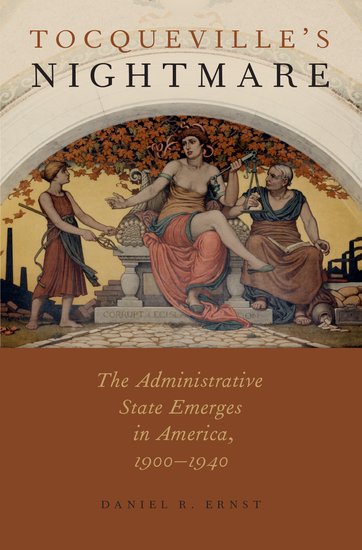
Daniel R. Ernst (Georgetown Law). Tocqueville's Nightmare (Oxford University Press, 2014).
"In the 1830s, the French aristocrat Alexis de Tocqueville wrote that 'insufferable despotism' would prevail if America ever acquired a national administrative state. Today's Tea Partiers evidently believe that, after a great wrong turn in the early twentieth century, Tocqueville's nightmare has come true. In those years, it seems, a group of radicals, seduced by alien ideologies, created vast bureaucracies that continue to trample on individual freedom. Tocqueville's Nightmare, shows, to the contrary, that the nation's best corporate lawyers were among the creators of 'commission government,' that supporters were more interested in purging government of corruption than creating a socialist utopia, and that the principles of individual rights, limited government, and due process were designed into the administrative state. "
—Publisher's website
William W. Buzbee (Georgetown Law). Fighting Westway (Cornell University Press, 2014).
"From 1971 to 1985, battles raged over Westway, a multibillion-dollar highway, development, and park project slated for placement in New York City. It would have projected far into the Hudson River, including massive new landfill extending several miles along Manhattan’s Lower West Side. . . . Buzbee reveals how environmentalists, citizens, their lawyers, and a growing opposition coalition, despite enormous resource disparities, were able to defeat this project supported by presidents, senators, governors, and mayors, much of the business community, and most unions. . . . Buzbee goes beyond the veneer of government actions and court rulings to illuminate the stakes, political pressures, and strategic moves and countermoves that shaped the Westway war, a fight involving all levels and branches of government, scientific conflict, strategic citizen action, and hearings, trials, and appeals in federal court."
Ran Hirschl (University of Toronto). Comparative Matters (Oxford University Press, 2014).
"Through an extensive exploration of comparative constitutional endeavours past and present, near and far, Hirschl shows how attitudes towards engagement with the constitutive laws of others reflect tensions between particularism and universalism as well as competing visions of who 'we' are as a political community. Drawing on insights from social theory, religion, history, political science, and public law, Hirschl argues for an interdisciplinary approach to comparative constitutionalism that is methodologically and substantively preferable to merely doctrinal accounts. The future of comparative constitutional studies, he contends, lies in relaxing the sharp divide between constitutional law and the social sciences."
—Publisher's website
Marc H. Greenberg (Golden Gate University). Comic Art, Creativity and the Law (Edward Elgar, 2014).
"The creation of works of comic art, including graphic novels, comic books, cartoons and comic strips, and political cartoons, is affected, and at times limited, by a diverse array of laws, ranging from copyright law to free speech laws. This book examines how this intersection affects the creative process, and proposes approaches that encourage, rather than limit, that process in the comic art genre. Attention to the role comic art occupies in popular culture, and how the law responds to that role, is also analyzed."
—Publisher's website
Lee Epstein (Washington University) & Andrew D. Martin (University of Michigan). An Introduction to Empirical Research (Oxford University Press, 2014).
"As the role of empirical methods in traditional legal scholarship and practice grows, new forms of education are needed for today's lawyers. All lawyers asked to present or assess empirical arguments need to understand the fundamental principles of social science methodology that underpin sound empirical research. An Introduction to Empirical Research presents that methodology in a legal context, explaining how empirical analysis can inform legal arguments; how lawyers can set about framing empirical questions, conducting empirical research, analyzing data, and presenting or evaluating the results. The fundamentals of understanding data, statistical models, and the structure of empirical arguments are explained in a way accessible to lawyers with or without formal training in statistics."
—From book jacket