Monday, November 10, 2014

Seeking Human Rights Justice in Latin America: Truth, Extra-Territorial Courts, and the Process of Justice

Jeffrey Davis (University of Maryland), Seeking Human Rights Justice in Latin America (Cambridge University Press, 2013).

"This book studies how victims of human rights violations in Latin America, their families, and their advocates work to overcome entrenched impunity and seek legal justice. Their struggles show that legal justice is a multifaceted process, the overarching purpose of which is to restore human dignity and prevent further violence. Uncovering, revealing, and proving the truth are essential elements of legal justice, and are also powerful tools to activate the process. When faced with stubborn impunity at home, victims, families, and advocates can carry on their work for legal justice by bringing cases in courts in other countries or in the Inter-American human rights system. These extra-territorial courts can jumpstart the process of legal justice at home."

Publisher's website


Thursday, November 6, 2014

What Stays in Vegas: The World of Personal Data—Lifeblood of Big Business—and the End of Privacy as We Know It

Adam Tanner (Harvard University). What Stays in Vegas: The World of Personal Data—Lifeblood of Big Business—and the End of Privacy as We Know It (PublicAffairs, 2014).

"Caesars’ dogged data-gathering methods have been so successful that they have grown to become the world’s largest casino operator, and have inspired companies of all kinds to ramp up their own data mining in the hopes of boosting their targeted marketing efforts. Some do this themselves. Some rely on data brokers. Others clearly enter a moral gray zone that should make American consumers deeply uncomfortable. . . . We live in an age when our personal information is harvested and aggregated whether we like it or not. And it is growing ever more difficult for those businesses that choose not to engage in more intrusive data gathering to compete with those that do."
—Publisher's Website

Monday, November 3, 2014

Outlawry, Governance, and Law in Medieval England

Melissa Sartore (West Virginia University Institute of Technology). Outlawry, Governance, and Law in Medieval England (Peter Lang, 2013).

"Outlawry, Governance, and Law in Medieval England evaluates the role of exclusionary practices, namely outlawry, in law and governance in England from the tenth through the thirteenth centuries. Traditional historical narratives dismiss exile, outlawry, and banishment as ineffective and weak methods of maintaining social order. More specifically, the present volume reassesses these forms of exclusion in matters of politics, law, and society, as well as their influence on increased use of imprisonment in later medieval England. Outlawry, Governance, and Law in Medieval England is essential reading for scholars working in this field but is also highly recommended as a text for courses that assess medieval law and the practice of outlawry as well as the development of English Common Law."
From publisher's website

Tuesday, October 28, 2014

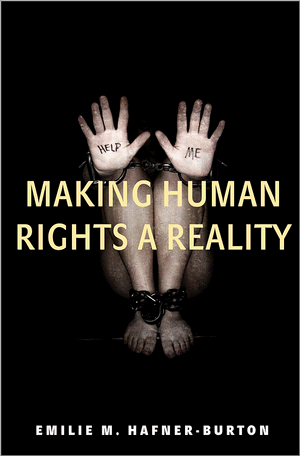
Making Human Rights a Reality

Emilie M. Hafner-Burton (University of California, San Diego), Making Human Rights a Reality (Princeton University Press, 2013).

"Emilie Hafner-Burton argues that more progress is possible if human rights promoters work strategically with the group of states that have dedicated resources to human rights protection. These human rights 'stewards' can focus their resources on places where the tangible benefits to human rights are greatest. Success will require setting priorities as well as engaging local stakeholders such as nongovernmental organizations and national human rights institutions. . . . To date, promoters of international human rights law have relied too heavily on setting universal goals and procedures and not enough on assessing what actually works and setting priorities . . . with a different strategy, human rights stewards can make international law more effective and also safeguard human rights for more of the world population."
From publisher's website

Thursday, October 16, 2014

Judging the Boy Scouts of America: Gay Rights, Freedom of Association, and the Dale Case

Richard J. Ellis (Willamette University). Judging the Boy Scouts of America (University Press of Kansas, 2014).

"As Americans, we cherish the freedom to associate. However, with the freedom to associate comes the right to exclude those who do not share our values and goals. What happens when the freedom of association collides with the equally cherished principle that every individual should be free from invidious discrimination? This is precisely the question posed in Boy Scouts of America v. James Dale, a lawsuit that made its way through the courts over the course of a decade, culminating in 2000 with a landmark ruling by the U.S. Supreme Court. In Judging the Boy Scouts of America, Richard J. Ellis tells the fascinating story of the Dale case, placing it in the context of legal principles and precedents, Scouts’ policies, gay rights, and the 'culture wars' in American politics."
—Publisher's Website